Contact Lens Care and Hygiene: The Rules That Protect Your Eyes
Rub, rinse, use fresh solution every time, keep water away and take your lenses out before sleep: the contact lens care habits that lower your risk of infection, by lens type.
Reviewed by Michel Geha, O.O.D., on September 26, 2026
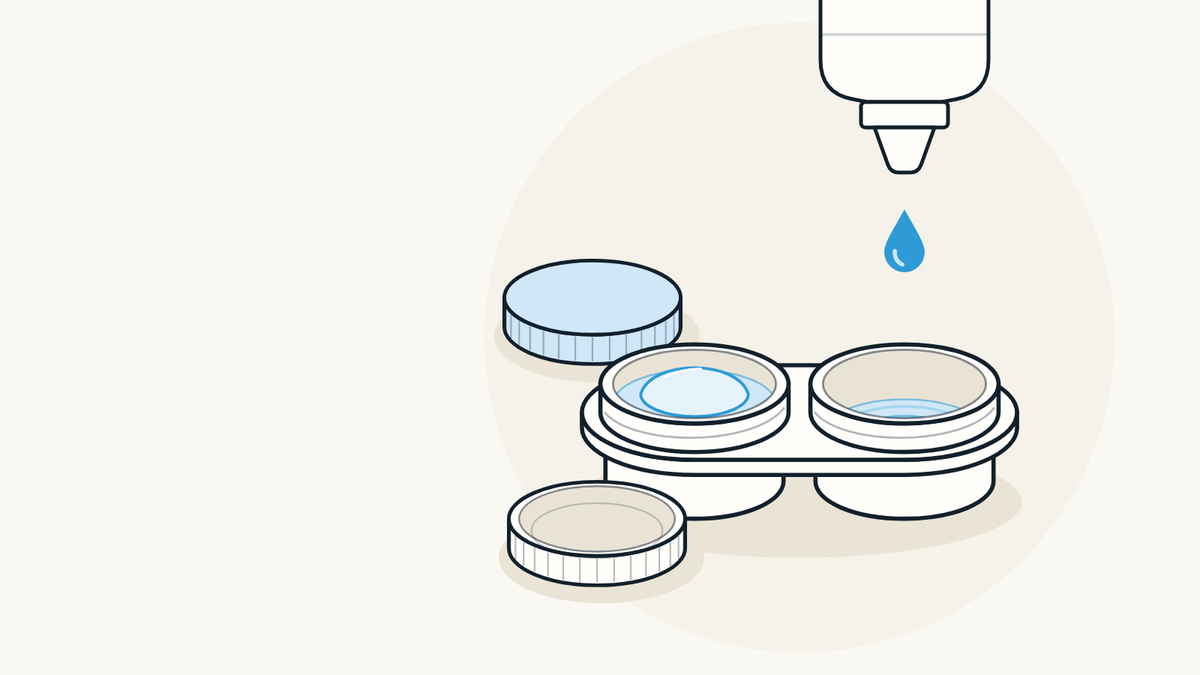
Good contact lens care comes down to a few habits: wash and dry your hands before touching your lenses, rub and rinse them with fresh solution every time you take them out, keep them away from all water, and remove them before you sleep unless your optometrist tells you otherwise.
This guidance draws on Health Canada, the Ordre des optométristes du Québec (OOQ, Québec's professional order of optometrists) and two U.S. agencies, the CDC and the FDA. For putting lenses in and taking them out, see our guide to wearing contact lenses for the first time.
How does contact lens care differ by lens type?
Daily disposables are single-use: they're thrown away as soon as you take them out, with no solution or case, but the other rules still apply. Reusable soft lenses are rubbed, rinsed and stored in fresh solution each time you take them out. Rigid lenses need suitable products. Your eye care professional (optometrist or optician) sets your routine at your fitting.
Two-week and monthly soft lenses
These need cleaning and disinfecting every time you take them out. With a multipurpose solution:
- Wash your hands with soap and water, then dry them well.
- Rub, then rinse each lens with solution. Never use water.
- Store it in the case filled with fresh solution, and never "top off" used solution: it makes disinfection less effective.
- Let it soak for at least the time on the label (often 4 to 6 hours) before putting it back in.
- Replace your lenses on schedule.
Hydrogen peroxide systems
These solutions clean and disinfect in one step and are often suggested for people allergic to multipurpose solutions. Use only the case that comes with each new bottle: in most systems, its platinum disc neutralizes the peroxide, which slowly turns into saline. A regular case won't neutralize it, and the disc in an old case wears out and may not neutralize it properly. That can cause stinging, burning, irritation or eye damage (FDA).

Always use fresh solution and let your lenses soak for the full time on the label (4 to 6 hours, according to the CDC) before wearing them. Never rinse your lenses with unneutralized peroxide right before putting them in, and never put it directly in your eyes.
Rigid gas permeable lenses
They need products suited to rigid lenses: use the ones your eye care professional recommended. Never use rigid-lens products on soft lenses (CDC). Daily-wear rigid lenses aren't worn overnight unless your optometrist tells you otherwise.
Which contact lens solution should you use, and can you reuse it?
The right solution is the one your eye care professional chose for your lenses and your eyes. And no, you can't reuse it: throw out used solution every time. Health Canada also advises against switching brands without asking your eye care professional, because of the risk of irritation or reactions. Whichever solution you use:

- Never use tap water, distilled water or saliva to clean or store your lenses.
- Don't pour solution into another bottle, even for travel: according to the OOQ, it would no longer be sterile.
- Don't use a solution longer than recommended after the bottle is opened.
Can you shower or swim with contacts in?
No. The CDC, the OOQ and the American Academy of Ophthalmology all say to take your lenses out before showering, swimming or using a hot tub. The FDA says not to expose them to any water: even treated drinking water, like Montréal's, is not sterile.
A UK study called it largely preventable through lens and hand hygiene and by keeping lenses away from water. The risk is never zero, though: the CDC notes that some people with good hygiene still get it.
Can you sleep or nap in contacts?
Not with daily-wear lenses. The OOQ says not to sleep in them, and the FDA says to take them out even for a nap. According to the CDC, sleeping in contacts raises the risk of a lens-related eye infection six- to eightfold.

Some soft lenses are approved for continuous wear of up to 30 days and nights. Even so, Health Canada notes that overnight wear, even with these lenses, is linked to a higher risk of serious eye infection. Only sleep in your lenses if your optometrist prescribed them for that.
How often should you replace your contact lens case?
At least every three months, and right away if it cracks or gets damaged (CDC, OOQ, American Academy of Ophthalmology). After each use:

- Empty the used solution.
- Rub and rinse the case with fresh solution, never water.
- Dry it with a clean tissue.
- Leave it upside down on a clean tissue, caps off, until the next use, unless your case's label says otherwise.
How many hours a day can you wear contacts, and how long do they last?
There is no single number for everyone. Your eye care professional sets your daily wearing time and replacement schedule based on your lenses and your eyes, and the OOQ asks you to stick to them. As for lifespan: daily disposables last one day, reusable soft lenses are most often replaced every two weeks or every month (sometimes weekly, or every three months or longer for some specialty lenses), and rigid lenses last longer.
When your eyes are likely to get dry or irritated, Health Canada suggests keeping artificial tears, a rewetting solution or your glasses handy. Many artificial tears, including gels, can't be used with contact lenses: ask your eye care professional which ones to use, and book a visit if dryness or irritation keeps coming back. See also our article on dry eye treatment.
Makeup and other everyday habits
- Put your lenses in before applying makeup, and take them out before removing it.
- Never share your lenses with anyone.
- Avoid decorative lenses (for a Halloween costume, for example) that weren't prescribed for you.
When should you see an optometrist?
If you can't reach your optometrist and the pain or blurred vision doesn't go away within a few hours of removing your lenses, or gets worse, Health Canada advises going to the nearest emergency department. Acanthamoeba keratitis can look like more common eye infections, so have the eye examined.
Also book a visit if your eye feels irritated after your lenses were exposed to water. Outside emergencies, PrimeVision recommends an eye exam every 2 years for adults and every year for children. If you wear contact lenses, the CDC advises a visit every year instead, or as often as your eye care professional recommends.
In Québec, according to the RAMQ, "emergency examinations performed by optometrists are covered for all insured persons experiencing a sudden eye problem." However, "you have to pay for certain additional non-covered services," such as treatment.
For insured people under the age of 18 or age 65 or over, the complete exam is covered at "1 examination per year" (some other situations also qualify). For an emergency or a follow-up, see our eye exams page.
Choosing lenses that fit your routine
The type of lens and the care product are chosen with your eye care professional. For a fitting or to order lenses, see our contact lenses page.
Sources
- Health Canada, "Contact Lenses"
- OOQ, "10 conseils pour les porteurs de lentilles" (in French)
- CDC, "About Cleaning, Disinfecting, and Storing Contact Lenses"
- CDC, "Preventing Eye Infections When Wearing Contacts"
- CDC, "About Acanthamoeba Keratitis"
- Cope JR et al. MMWR 2018;67:877-881
- FDA, "Contact Lens Care"
- FDA, "Contact Lens Risks"
- FDA, "Hydrogen Peroxide Solution"
- FDA, "Types of Contact Lenses"
- American Academy of Ophthalmology (AAO), "How to Take Care of Contact Lenses"
- AAO, "Contact Lenses for Vision Correction"
- Carnt N et al. Br J Ophthalmol 2018;102:1621-8
- RAMQ, "Optometric services"
This article is general information and does not replace an eye exam.