Wearing Contact Lenses for the First Time: What to Expect
How to put in and take out your first contact lenses, how long it takes to get used to them, and which signs mean you should get your eyes checked right away.
Reviewed by Michel Geha, O.O.D., on September 26, 2026
Wearing contact lenses for the first time mostly takes practice. A lens that is in properly should feel comfortable and give you clear vision. Some people need a few days to get used to contacts, sometimes longer with rigid lenses, and your optometrist or licensed optician sets how many hours to wear them at first.
How do you put in contact lenses for the first time?
Keep your nails short, sit in front of a mirror and handle the lens with your fingertips.

- Wash your hands with a mild soap free of creams and fragrance, then rinse and dry them with a lint-free towel.
- Always start with the same eye so you never mix up your lenses.
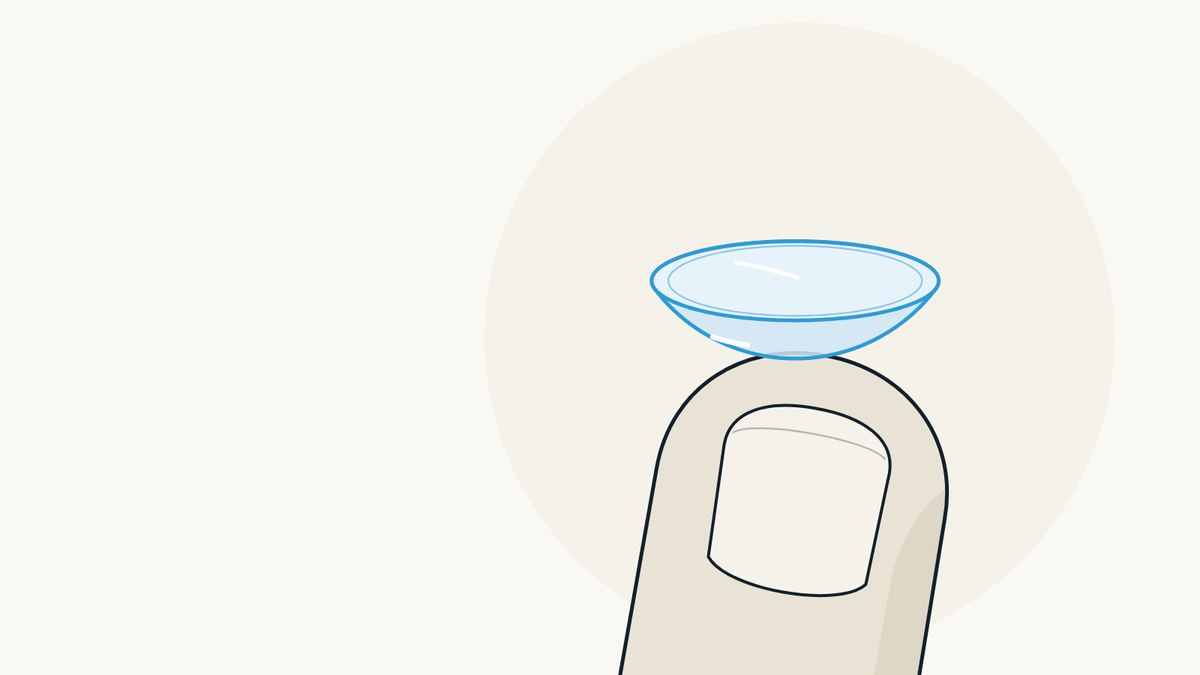
- Place the lens on the tip of the index finger of your dominant hand. It should be clean, undamaged and shaped like a small bowl with the edges turned up. If the edges flare out like a lid, it's inside out.
- Hold your upper eyelid with your other hand and pull the lower one down with the middle finger of the hand holding the lens.
- Look straight ahead or up at the ceiling, then gently place the lens on your eye.
- Close your eyes slowly, blink a few times and check in the mirror that the lens is centred.
Why can't I get my contacts in?
At first, your eye tends to blink shut. Hold your upper eyelid and lashes with your other hand, and keep the lower lid pulled down until the lens touches your eye. At our clinic, first-time wearers are shown the technique.
How do you take out contact lenses?
For soft lenses (rigid lenses come out differently):
- Wash and dry your hands.
- Look up and pull down your lower eyelid with your middle finger.
- With your index finger, slide the lens down onto the white of your eye.
- Gently pinch it off between your thumb and index finger, without using your nails.
How long does it take to get used to contacts?
Some people need a little time, typically just a few days. Soft lenses are usually more comfortable at first; rigid gas permeable lenses can take longer. If you wore glasses, objects may also look a slightly different size. According to the American Academy of Ophthalmology, this adjustment should take no more than two or three weeks. With multifocal lenses, adapting can take up to a month.

How should new contacts feel?
| What you notice | What to do |
|---|---|
| Clear vision, comfortable lens | Nothing special: it's in properly. Keep your follow-up visit. |
| The lens stings or feels scratchy | Take it out and check that it isn't inside out, dirty or damaged. If the discomfort returns, leave it out and call your optometrist or optician. |
| Dry or irritated eyes | Take your lenses out and give your eyes a rest. If the irritation lasts or comes back, call your optometrist or optician and ask before using any drops: dry eye makes lens wear harder (see our article on dry eye). |
| Very red, painful or very light-sensitive eye, discharge, or blur that doesn't clear | Take your lenses out, don't put them back in and get seen right away. |
How long should you wear contacts the first time?
No number applies to everyone: wearing time depends on your eyes and your lenses. Follow the schedule your optometrist or optician gives you, even if your lenses still feel comfortable after that.

Wearing time is often built up gradually, but how that's done varies from one professional to another, because there is little solid evidence on the ideal approach.
Can you nap with contacts in?
Also take your lenses out before showering, swimming or using a hot tub: the water isn't sterile. Our article on contact lens care covers these rules.
Why are my new contacts blurry?
Check these simple causes first:
- Lens inside out: it should form a small bowl.
- Lenses switched: if your eyes need different corrections, the right lens won't suit the left eye.
- Lens off-centre: close your eyes, roll them gently, then blink.
- Astigmatism: lenses that correct it need to keep the right orientation on the eye. If they rotate, vision blurs and a different lens may be needed (see our article on astigmatism).
- Near vision after 40: presbyopia can make reading harder with contacts than with glasses; talk to your optometrist or optician.
If the blur lasts more than a few days of regular wear, have your prescription and fit checked. If it comes with a very red, painful or very light-sensitive eye, take your lenses out immediately and get seen right away.
Is it healthier to wear glasses or contacts?
Glasses don't touch the eye, so they carry no risk of a corneal infection. Contact lenses do carry that risk, but serious infections are rare when lenses are worn and cared for as directed. Health Canada notes that they are medical devices.

An Australian study published in 2008 counted about 2 corneal infections (microbial keratitis) per year for every 10,000 people wearing conventional soft (hydrogel) or daily disposable lenses they removed each night. Rates varied by lens type: about 12 per 10,000 with silicone hydrogel lenses worn during the day only, and about 20 to 25 per 10,000 among people who regularly wore their lenses overnight. According to the authors, newer lens types have not lowered the number of infections.
Other risk factors included a poorly kept lens case, smoking and less than six months of experience.
Always keep an up-to-date pair of glasses for days when you need to take your lenses out.
Is a glasses prescription enough for contacts?
Not quite. In Québec, the same prescription covers glasses and contact lenses, and the eye exam includes an assessment of whether you can wear contacts. If the optometrist finds a reason you shouldn't wear contacts, it is written on the prescription, which can then be used for glasses only.
The lens parameters (material, curvature and so on) and the type of lens, however, are set during the fitting, by the optometrist or licensed optician who supplies your lenses.
Health Canada advises having your contacts prescribed and fitted by a qualified eye care professional and attending follow-up visits. To see how this works at our clinic, visit our page on contact lens fittings in Montréal.
When should you see an optometrist?
Sources
- CAO, Wear and Care for Contact Lenses.
- AAO, How to Put In Contact Lenses, 2023.
- AAO, How do I get a contact lens out from the top of my eye?, 2023.
- AAO, Should you allow a few days to get used to contact lenses?, 2024.
- AAO, Why does everything look bigger after switching to glasses?, 2015.
- CDC, About Contact Lens Types, 2025.
- College of Optometrists, The history and use of gradual adaptation in soft contact lenses, Optometry in Practice, 2021.
- AAO, Why do my contact lenses keep shifting out of place?, 2018.
- CAO, Dry Eye (Ocular Surface Disease).
- FDA, Contact Lens Risks.
- FDA, Contact Lens Care.
- CDC, Preventing Eye Infections When Wearing Contacts, 2025.
- CDC, Corneal Infections Associated with Sleeping in Contact Lenses: Six Cases, United States, 2016-2018, MMWR, 2018.
- Stapleton F. et al., The incidence of contact lens-related microbial keratitis in Australia, Ophthalmology, 2008.
- Health Canada, Contact Lenses.
- OOQ, Questions fréquentes (grand public), in French.
This article is general information and does not replace an eye exam.