Daily vs Monthly Contact Lenses: How to Choose
Daily lenses are worn for one day and thrown away; monthly lenses are cleaned and stored every night. Safety, care, overnight wear, switching types and who each one suits.
By Michel Geha, O.O.D.
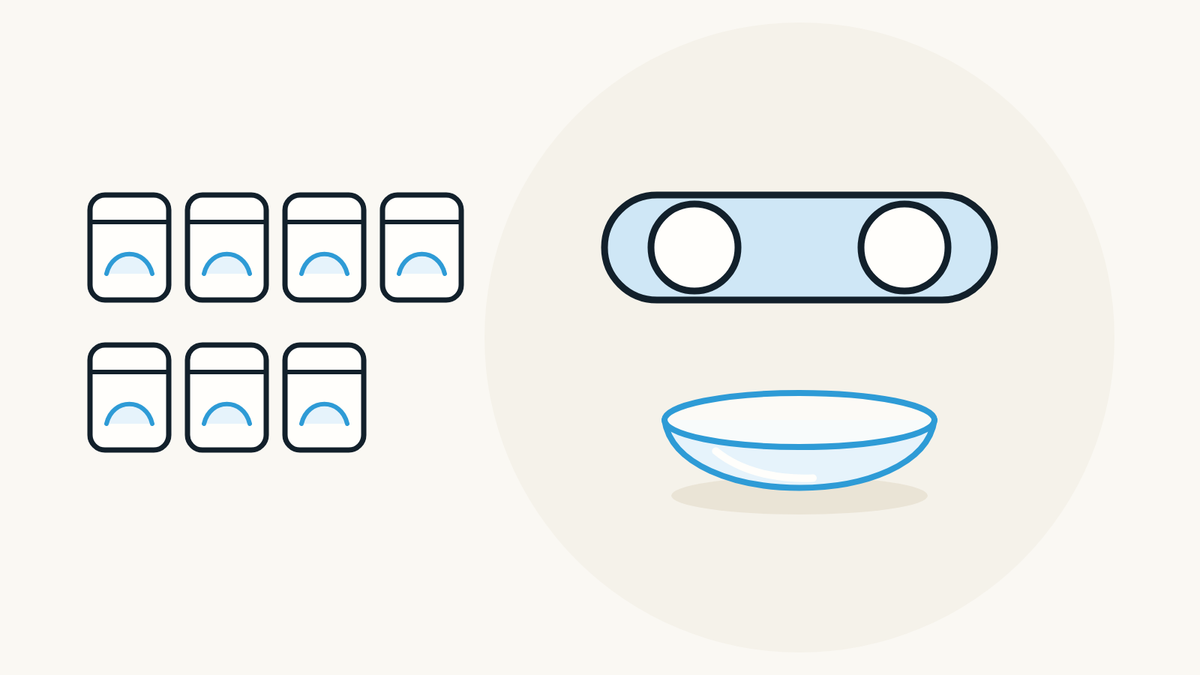
The difference between daily and monthly contact lenses is the replacement schedule. A daily lens is worn for one day and thrown away at night. A monthly lens is worn for up to a month, but it comes out and gets cleaned every night. The right choice depends on your eyes and on how you wear them.
What is the difference between daily and monthly contact lenses?
How long the lens lasts. According to the Centers for Disease Control and Prevention (CDC), a disposable lens, as the U.S. FDA defines it, is used once: on a daily schedule, you open a new pair every day and throw it away at night. Planned replacement lenses come out every night and are worn again for several days; their schedule runs from 7 to 30 days.
In between, there are also two-week lenses. The American Academy of Ophthalmology (AAO) counts all of them as daily wear lenses: you wear them while you are awake and take them out to sleep. Your optometrist sets the schedule that suits you.


Are daily contact lenses safer?
They remove one source of risk: the case and the solution. According to a CDC report published in 2015, daily disposable wearers might have a lower risk of infection if they really throw their lenses away every day, since they use no case and no solution. The same report notes that many of them still used a case, sometimes with tap water.
A case-control study at Moorfields Eye Hospital in London, published in 2008 in the journal Ophthalmology, did not find fewer corneal infections among daily disposable wearers. It did find that vision loss was less common among them than among wearers of reusable soft lenses. So the hygiene rules apply to every type.

What care do monthly lenses need?
A cleaning every night, with the solution you were prescribed. The CDC says to rub and rinse your lenses with disinfecting solution, to put fresh solution in the case without mixing it with old solution, to let the case dry upside down with the caps off, and to replace it at least every three months.
The AAO adds that you should never wear lenses stored for 30 days or longer without disinfecting them again. Our article on contact lens care goes through each step.

Who are daily lenses for?
Often for people who wear contacts once in a while. According to the AAO, some ophthalmologists recommend daily disposable lenses if you only wear them occasionally: for sports, an evening out or a trip, a new pair comes out of its pack and goes in the trash at night.
They need little care, but they still have rules: according to the CDC, wearing a daily lens for more than one day may cause discomfort or other complications. A daily lens is not stored for the next day.

Who are monthly lenses for?
For people who wear their lenses regularly and keep a care routine every night. The CDC describes that routine for all reusable daily wear lenses: take the lenses out each night, rub and rinse them with solution, then store them in a clean case filled with fresh solution.
The replacement date matters as much as the cleaning. The CDC says that wearing lenses longer than the recommended schedule can lead to discomfort or other complications. Our article on how many hours a day you can wear contacts explains how to follow your schedule.

Can you sleep in daily or monthly lenses?
No, unless your optometrist prescribed extended wear lenses. According to the CDC, daily wear lenses are not designed for overnight wear, and sleeping in them increases the chance of a serious eye infection. Extended wear lenses are worn from one to six nights or up to 30 days, depending on your eye care provider's evaluation.
In the Moorfields study, overnight wear clearly raised the risk of infection, whatever the lens type. Our article Can you sleep in your contact lenses? explains what to do if you fell asleep with your lenses in.

Can you switch from monthly to daily lenses?
Yes, with your optometrist. The CDC says to talk to your eye care provider before changing your contact lens type. According to the FDA, brands do not all have the same water content or shape, and the choice of lens should be based on an exam, not on a phone call.
A trial shows how the new lens sits on your eye and whether your vision stays clear. Our page on contact lenses in Montréal covers fittings and trial lenses.

What about water, showers and makeup?
The same rules for both types. The CDC says to keep lenses away from all water and to take them out before swimming or showering. The FDA adds that tap, bottled or distilled water should never be used on your lenses. Our article on showering and swimming with contact lenses has the details.
For makeup, the FDA advises putting your lenses in before your makeup, taking them out before you remove your makeup, and applying sprays such as hairspray or deodorant before you put your lenses in.


Where can you try daily or monthly lenses in Montréal?
At PrimeVision, 9520 Boulevard de l'Acadie, Suite 222, in Montréal (Ahuntsic), optometrists and a licensed optician work under one roof. The clinic fits silicone hydrogel soft contact lenses only, as daily or planned replacement lenses depending on what suits your eyes. Most trial lenses are available the same day when in stock, otherwise in 2 to 5 business days, and the follow-up after a first fitting usually takes place a few days to a week later. RAMQ covers eye exams for children under 18 and adults 65+.
For an up-to-date prescription before a fitting, book an eye exam. If you are still deciding between the two options, read Glasses or contact lenses: which should you choose?

Sources
- About Contact Lens Types, Centers for Disease Control and Prevention, 2025.
- Preventing Eye Infections When Wearing Contacts, Centers for Disease Control and Prevention, 2025.
- Contact Lens Wearer Demographics and Risk Behaviors for Contact Lens-Related Eye Infections, United States, 2014, MMWR, CDC, 2015.
- Dart JK, Radford CF, Minassian D, Verma S, Stapleton F. Risk factors for microbial keratitis with contemporary contact lenses: a case-control study. Ophthalmology, 2008.
- Contact Lenses for Vision Correction, American Academy of Ophthalmology.
- How to Take Care of Contact Lenses, American Academy of Ophthalmology.
- Types of Contact Lenses, U.S. Food and Drug Administration.
- Everyday Eye Care, U.S. Food and Drug Administration.
- Contact Lens Risks, U.S. Food and Drug Administration.
- Buying Contact Lenses, U.S. Food and Drug Administration.
This article is general information and does not replace an eye exam.