Getting Used to Progressive Lenses: How Long It Takes and What Helps
How long it takes to adjust to progressive lenses, and how to tell a fitting problem from a normal learning curve.
Reviewed by Michel Geha, O.O.D., on September 26, 2026
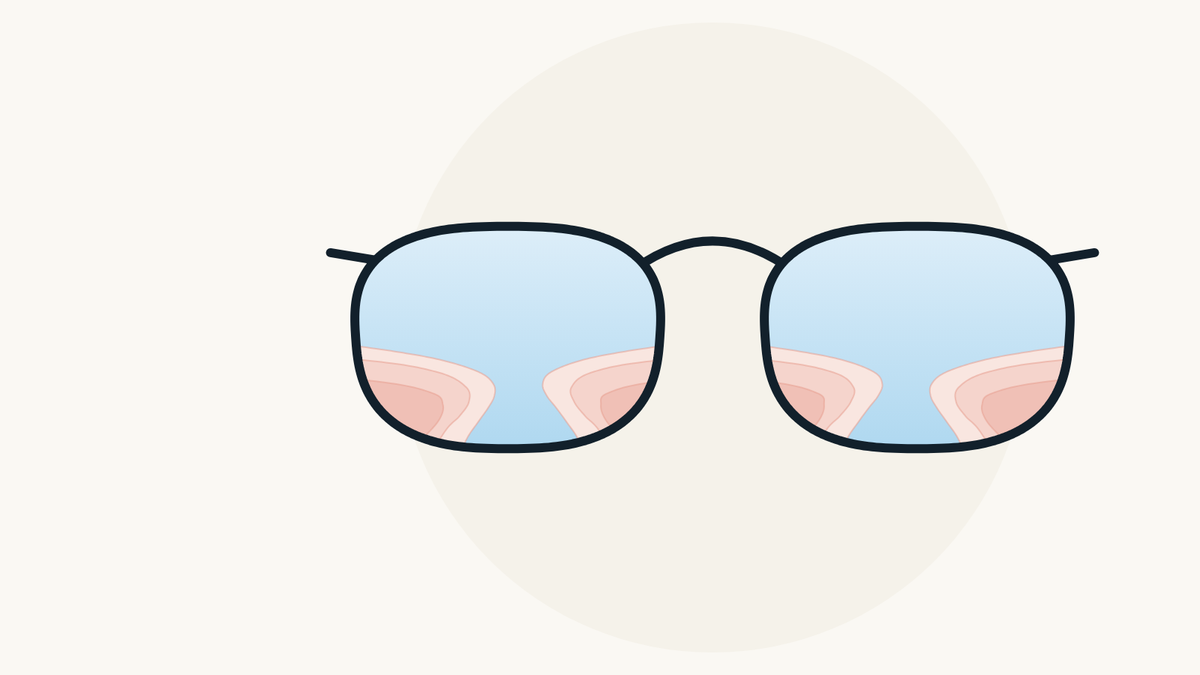
Most people get used to progressive lenses in one to two weeks of continuous wear; for some, finding each zone without thinking can take up to a month or two, according to the American Academy of Ophthalmology. Slight blur at the sides and a swimming feeling are normal at first. Distance vision straight ahead, though, is usually clear from the start.
If these are your first progressive lenses, here is what to expect. For choosing the lenses, see our page on progressive lenses fitted in Montréal.
Why do progressive lenses take getting used to?
Presbyopia is usually noticed in your forties, according to the Canadian Association of Optometrists. A progressive lens corrects it by putting every distance into one lens: the top for distance, the middle for intermediate (your screen) and the bottom for reading, with no visible line.

The trade-off is that the sides of the lens slightly distort the image. Your brain has to learn to look through the right zone, and that is what takes time.
How long does it take to adjust to progressive lenses?
The Canadian Association of Optometrists advises wearing new multifocals continuously for the first week or two. Most people get used to them in one to two weeks of continuous wear; for some, finding each zone without thinking can take up to a month or two, according to the American Academy of Ophthalmology. Even so, the discomfort should ease little by little.

The first few days
You may feel a little off-balance, or slightly queasy, when you look through the wrong part of the lens. On stairs, your feet can look bigger through the bottom of the lens. A new prescription can also bring mild eye strain or a headache in the first week.
The weeks that follow
Gradually the movement becomes automatic: you turn your head toward what you want to see instead of moving only your eyes. A small University of Waterloo study (10 participants) found that first-time wearers tended to add head movements as they adapted, with strategies that varied from person to person.
How to get used to progressive lenses faster
- Put them on first thing in the morning and wear them all day, without switching back to your old pair, as the Canadian Association of Optometrists recommends. The American Academy of Ophthalmology also advises wearing them as often as possible.
- Point your nose at what you want to see, then tip your chin up or down until it comes into focus.
- To read, lower your eyes. Hold the text about 40 cm (16 inches) away and move the page or your phone rather than your head.
- Look ahead when you walk rather than at your feet.
- Keep the frame adjusted. If it slides or tilts, the lens zones are no longer in front of your eyes.
Is it normal for progressive lenses to be blurry at first?
On the sides, yes. The image can look slightly distorted when you move your eyes sideways. That is why you learn to turn your head.
Straight ahead at a distance, usually not. An ophthalmologist answering for the American Academy of Ophthalmology explains that distance vision is generally good from the start. If it stays blurry through the top of the lens, two things need checking: how the lens is centred in the frame, and the prescription itself.
Blur or headaches that won't go away: are your lenses fitted correctly?
Possibly not. A progressive lens only works well when its zones sit in front of your pupils. So the optician takes measurements with the frame you chose, including the pupillary distance, measured for each eye, and the fitting height.

In Québec, these measurements are generally not part of the optometrist's prescription: they are taken by the professional who sells you the glasses. One study of these measurements found that some, such as fitting height, vary more from one reading to the next, and that this imprecision could throw the lens off-centre and affect vision or adaptation.
These signs call for a check:
- distance vision stays blurry looking straight ahead after a few days;
- you have to raise or lower your chin a lot to find a clear spot;
- dizziness or headaches aren't easing after a week or two.
If something feels off, go back to the optician who made your glasses. If you bought them from us, our optician can check the measurements and fit. If the fit is fine, the optometrist can check your prescription.
Stairs and driving: what to watch for
Progressive lenses and computer screens
In an all-purpose progressive lens, the zone for your screen sits in the middle of the lens and is narrower than in a lens designed for computer work. If the monitor is too high, you will tend to lift your chin to find the clear spot.

The American Optometric Association suggests placing the screen 15 to 20 degrees below eye level (measured to the centre of the screen), about 50 to 70 cm (20 to 28 inches) away.
For long screen days, office lenses give more of the lens to intermediate vision. In a German trial of 190 screen workers, 84% preferred them for that work.
Another, smaller study (23 participants), co-authored by researchers from a lens manufacturer, had more mixed results. The office lenses gave a wider clear zone at the monitor but no clear distance vision: they are for the desk, not for driving. After eight more weeks of free use, about half the participants preferred the general-purpose progressives instead.
Should you wear progressive lenses all the time?
While you adapt, yes, continuously for the first week or two. After that, it depends on your prescription and what you do all day: some people keep a separate pair for long reading sessions or the computer.
What if you can't get used to progressive lenses?
First have the centring, the frame and the prescription checked. If needed, the optician can also suggest a different type of progressive lens. If you are still uncomfortable after that, there are other ways to handle presbyopia: bifocals, separate glasses for distance and reading, lenses for screen work, multifocal contact lenses, or monovision (one eye corrected for distance, the other for near).
The optician and optometrist can help you compare these options and choose frames that suit progressive lenses. Lens types are covered on our progressive lenses page, and our guide to first-time contact lenses explains where to start.
When to see an optometrist
Sources
- American Academy of Ophthalmology. Pros and Cons of Progressive Lenses, 2023
- American Academy of Ophthalmology. How long will it take for the blurry vision with progressive bifocals to stop?, 2014
- American Academy of Ophthalmology. Would a small increase in a glasses prescription cause headaches or eye strain?, 2025
- Canadian Association of Optometrists. Multifocal Lenses, 2024
- Canadian Association of Optometrists. Presbyopia, 2024
- Hutchings N et al. Eye and head movement alterations in naïve progressive addition lens wearers. Ophthalmic Physiol Opt, 2007
- Garcia-Espinilla O et al. Comparison of physiognomy and frame angle parameters using different devices to prescribe progressive addition lenses. Clin Exp Optom, 2022 (published online 2021)
- Ordre des optométristes du Québec. Questions fréquentes du grand public (in French)
- Kennan L. Talking to patients about their new spectacles. Community Eye Health, 2024
- Lord SR et al. Multifocal glasses impair edge-contrast sensitivity and depth perception and increase the risk of falls in older people. J Am Geriatr Soc, 2002
- Haran MJ et al. Effect on falls of providing single lens distance vision glasses to multifocal glasses wearers: VISIBLE randomised controlled trial. BMJ, 2010
- American Optometric Association. Computer vision syndrome
- Kolbe O, Degle S. Presbyopic personal computer work: a comparison of progressive addition lenses for general purpose and personal computer work. Optom Vis Sci, 2018
- Jaschinski W et al. Comparison of progressive addition lenses for general purpose and for computer vision: an office field study. Clin Exp Optom, 2015
- Régie de l'assurance maladie du Québec. Optometric services
This article is general information and does not replace an eye exam.