Hyperopia: Symptoms, Causes and How It Differs from Presbyopia
Farsightedness is a focusing problem, not an eye disease. How to recognize it in children and adults, how it differs from presbyopia and how it is corrected.
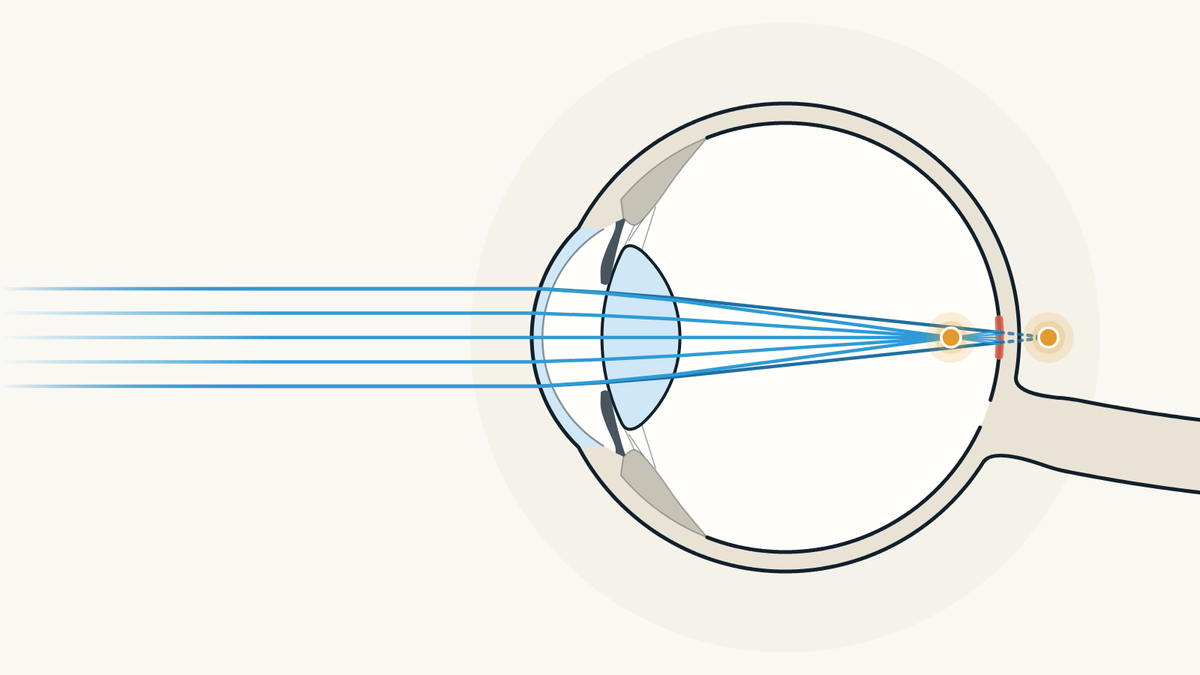
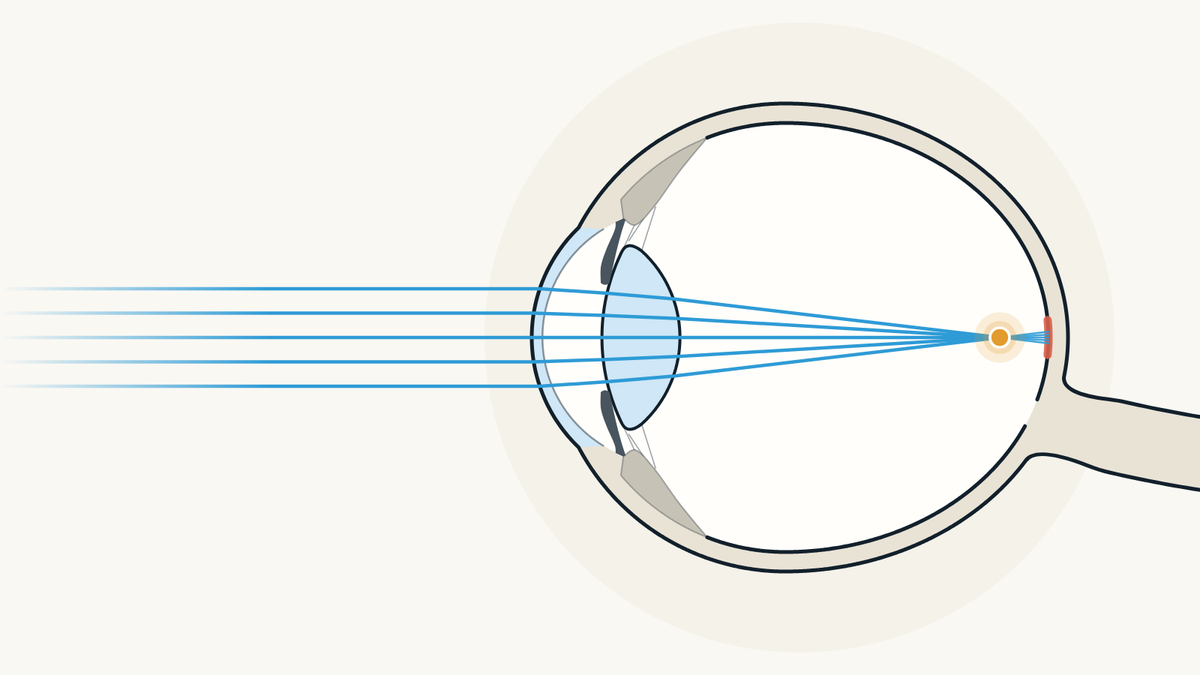
Hyperopia, or farsightedness, is a refractive error: the eye is slightly too short, or the cornea too flat, so light comes into focus behind the retina instead of on it. To see clearly, the eye has to work harder to focus, especially up close. It is a focusing problem rather than an eye disease, and it can be corrected.

What are the symptoms of hyperopia?
According to the Canadian Association of Optometrists (CAO), hyperopia can show up as tired eyes or headaches, not just blur. The eye makes an involuntary effort to keep distance vision clear, and an even greater effort up close, which can cause:
- trouble keeping print or a phone screen in focus
- eye strain, or eyes that ache or burn
- headaches after reading or other close work
- blurred vision, once the eye can no longer compensate
- in children, difficulty reading or an eye that crosses
What does someone with hyperopia see?
According to the American Academy of Ophthalmology (AAO), near objects are usually blurrier than distant ones. Even distance vision takes effort, though, and higher hyperopia, or a lens that stiffens with age, can blur it too.

What is the main cause of hyperopia?
The eye is shorter than average from front to back, or the cornea is too flat (AAO, CAO). Genes play a part: a child is more likely to be farsighted if a parent is, but genetics is only one of several factors (AAO).
Most young children are mildly farsighted. As the eye grows longer, that mild hyperopia shrinks or disappears (AAO). Many people have some hyperopia without knowing it (CAO). A global meta-analysis estimated that about 31% of adults are farsighted, counting even low hyperopia (over +0.50 dioptres), though definitions vary between studies.
Hyperopia vs myopia vs presbyopia: what's the difference?
Hyperopia and presbyopia both make reading harder, but for different reasons. Hyperopia comes from the shape of the eye and is often present from childhood. Presbyopia is a normal part of aging: after 40, the lens inside the eye becomes more rigid and cannot change shape as easily (AAO). People often notice it by holding a book or phone farther away.
You can have both. A farsighted person who already wears glasses may later need bifocals or progressive lenses (AAO). Presbyopia also tends to show up sooner in farsighted people, and taking their glasses off to read makes near vision even blurrier.
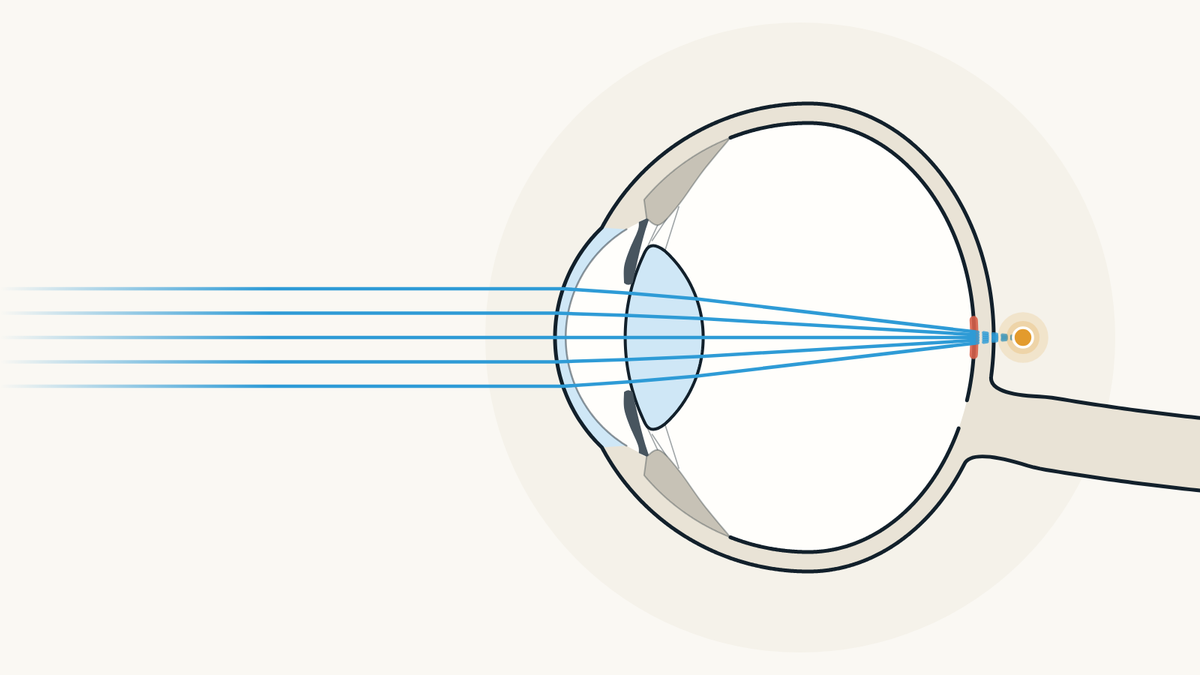
As for farsighted vs nearsighted, myopia is the opposite: the eye is too long or the cornea too curved, so distance vision is what blurs (CAO).
| Hyperopia (farsighted) | Myopia (nearsighted) | Presbyopia | |
|---|---|---|---|
| What happens | Eye too short or cornea too flat: image behind the retina | Eye too long or cornea too curved: image in front of the retina | Lens less flexible with age |
| What is blurry | Mostly near, sometimes far as well | Far | Near |
| When it appears | Often from childhood, sometimes noticed later | Often at school age | Shortly after 40 |
| Type of lens | Convex (plus power) | Concave (minus power) | Reading glasses, bifocals or progressive lenses |
Astigmatism is a separate issue: a cornea or lens that is curved more in one direction than the other blurs or distorts vision at all distances, and it often comes with hyperopia or myopia (CAO). Our article on astigmatism explains it in detail.
Hyperopia in children: why a screening doesn't replace a full eye exam
Mild hyperopia is normal in young children. Higher hyperopia, left untreated, can lead to amblyopia (lazy eye), strabismus and vision loss (AAO). Being more farsighted in one eye than the other can also cause amblyopia, ideally treated before age 7 or 8 (AAO).
In a US study of 492 children aged 4 and 5 (VIP-HIP), uncorrected hyperopia of 4 dioptres or more was associated with lower scores on an early-literacy test. That is an association, not proof that hyperopia causes reading difficulties.
The Ordre des optométristes du Québec (OOQ) notes that 61% of Canadian parents mistakenly believe they can spot their child's vision problems. Our children's eye exams page explains what the visit involves.
Can hyperopia be corrected?
Yes. Glasses and contact lenses correct it with convex, plus-powered lenses that change the way light enters the eye (AAO, AOA). They work while you wear them, without changing the shape of the eye.

For adults, laser surgery can be considered if you are a suitable candidate (CAO), although LASIK can only treat lower amounts of hyperopia. Refractive lens exchange, which replaces the eye's natural lens with an artificial one, is another option (AAO). As for natural fixes, there is no evidence that eye exercises, vitamins or pills can prevent or reverse hyperopia (AAO).
Do farsighted people need to wear glasses all the time?
Not necessarily. It depends on the amount of hyperopia, your age, your symptoms and your daily activities (AAO). In mild cases, the eyes may compensate well enough to see at a distance without glasses, although glasses may be recommended for reading and computer work. In more significant cases, the optometrist may recommend glasses or contact lenses full time (CAO).
For a child, follow the optometrist's wearing schedule, especially if amblyopia is being treated (AAO). When hyperopia makes a child's eye turn inward (accommodative esotropia), the American Association for Pediatric Ophthalmology and Strabismus (AAPOS) says the glasses should be worn all the time. With any new glasses, allow a few days to adjust (CAO). Wearing them regularly helps you get used to them, and if the discomfort persists, have them checked by your optician.
When should you see an optometrist?
Which glasses suit a farsighted prescription?
Lenses for hyperopia are thicker in the centre than at the edge and make the eyes look bigger. With a stronger prescription, three choices reduce these effects:

- aspheric lenses, with a flatter curve, which are thinner and lighter and reduce the magnified look
- a higher-index material, which thins the lens further, though the gain is smaller than for nearsighted lenses
- a smaller frame (but not too small), since a large frame needs larger, thicker lenses
With a low prescription, a high-index material makes almost no difference to thickness (All About Vision). The right balance depends on your prescription and your face, which is where an optician comes in. See our prescription glasses with thinner lenses, or learn how to choose a frame with an optician.
Sources
- CAO. Hyperopia (Farsightedness)
- AAO. Farsightedness: What Is Hyperopia?
- American Optometric Association (AOA). Hyperopia (farsightedness)
- AAO. What Is Presbyopia?
- AAO. Concave, convex, and cylinder lenses
- CAO. Myopia (Nearsightedness)
- CAO. Astigmatism
- AAO. Amblyopia (Lazy Eye)
- Kulp MT et al. Uncorrected Hyperopia and Preschool Early Literacy (VIP-HIP). Ophthalmology, 2016
- Hashemi H et al. Global and regional prevalence of refractive errors (meta-analysis). J Curr Ophthalmol, 2018
- OOQ. La vision et l'enfant, 2023 (in French)
- AAPOS. Accommodative Esotropia
- AAO. What Is Glaucoma?
- Régie de l'assurance maladie du Québec (RAMQ). Optometric services
- All About Vision. High-index lenses
- All About Vision. Les verres à indice élevé (in French)
This article is general information and does not replace an eye exam.