Myopia (Nearsightedness): Causes, Symptoms and Treatment Options
Myopia makes distant objects look blurry. Here is what causes it, why it tends to increase during childhood, what research says about screens and outdoor time, and when to see an optometrist.
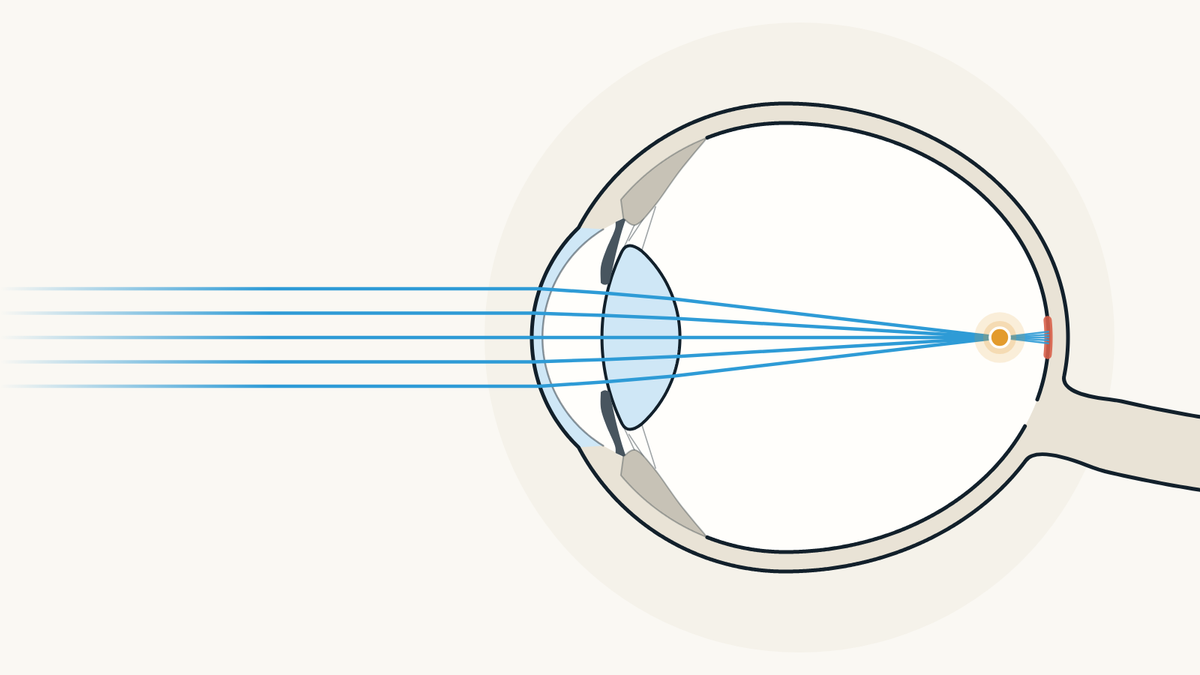
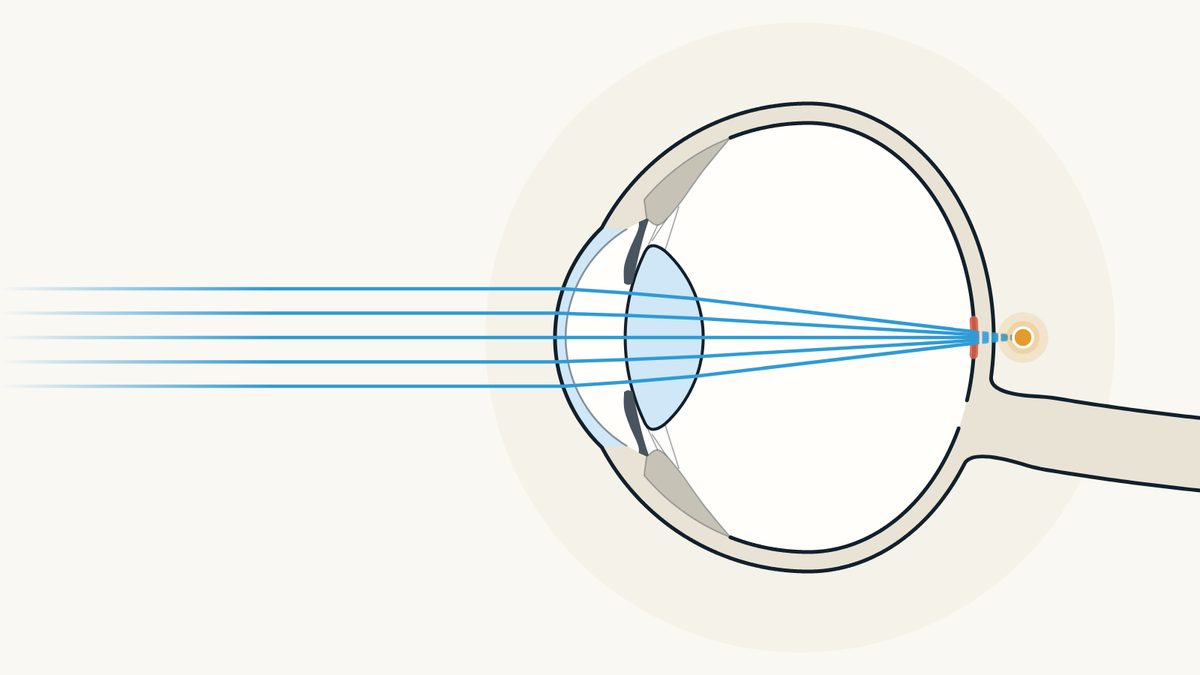
Myopia, or nearsightedness, is a common vision condition in which distant objects look blurry while close objects stay clear. It happens when the eye is too long or the cornea is too steeply curved, so light focuses in front of the retina instead of on it. Glasses or contact lenses correct the blur.

How does a nearsighted person see?
Up close, things look sharp, but only within a distance that gets shorter as myopia increases. The farther away you look, the blurrier things get: road signs, the whiteboard at school, a movie screen or the TV. Nearsighted people often squint and may get eye strain or headaches.

Myopia is measured in dioptres and shows on your prescription with a minus sign (for example, -2.00). The bigger the number after the minus sign, the stronger the myopia. High myopia generally starts at -6.00 dioptres (some studies use -5.00).
Myopia vs hyperopia (and astigmatism)
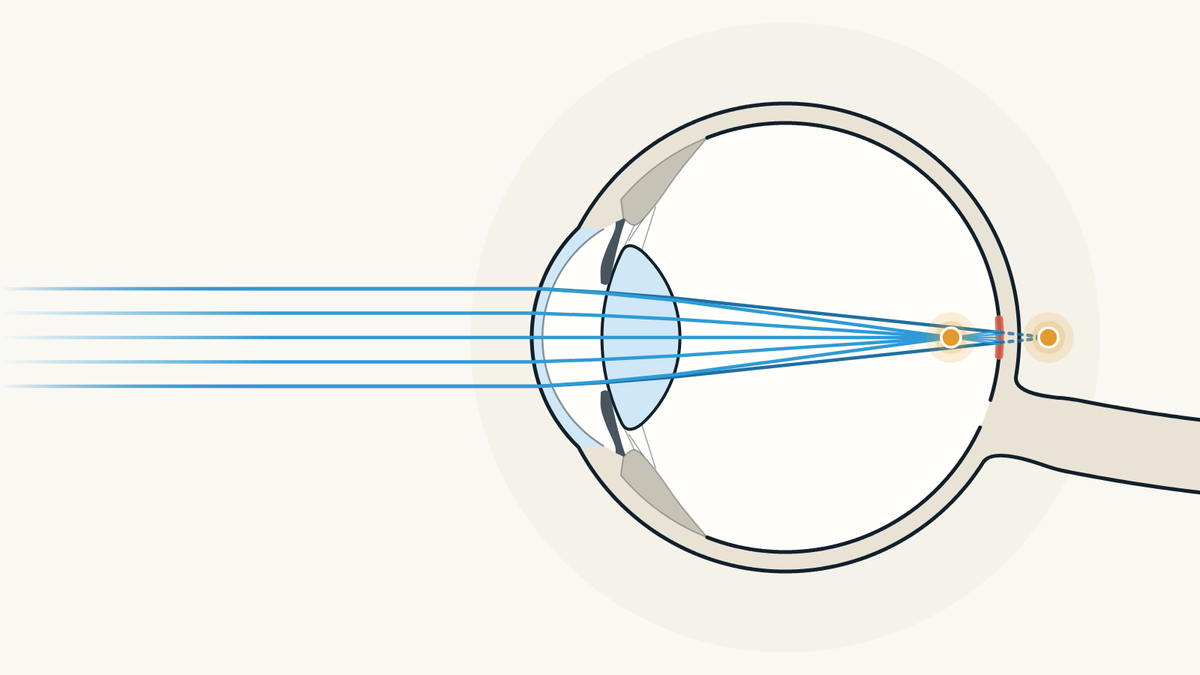
Hyperopia, or farsightedness, is roughly the opposite: the eye is too short or the cornea too flat, so light focuses behind the retina. Astigmatism comes from a cornea (or the eye's lens) that is not curved equally in every direction, so the eye has two different powers and vision blurs at all distances. This condition often occurs together with myopia, and the same prescription corrects both. See our articles on hyperopia and astigmatism.
What causes myopia?
There is no single cause. Two groups of factors are involved:
- Genetics. According to the Canadian Association of Optometrists (CAO), a child with a nearsighted parent is more likely to become nearsighted, and their myopia tends to progress faster. The risk is higher when both parents are nearsighted.
- Environment. The CAO notes that near work, such as reading and tablet use, is correlated with myopia in children, though a correlation does not prove cause. Time outdoors, on the other hand, is linked to less myopia.
Myopia is also becoming more common. According to the Ordre des optométristes du Québec (OOQ), myopia in children has doubled over the past 20 years and is appearing earlier.
Do screens cause myopia?
Possibly, but it has not been proven. A 2021 review of 33 studies found an association between smartphone or tablet time and myopia. None measured screen time reliably, however, and the authors conclude that smart device exposure "might be associated with an increased risk of myopia."
The evidence for outdoor time is stronger. In a trial of 1,903 Grade 1 children in China, schools that added one extra 40-minute outdoor class each school day, and also encouraged parents to take their children outdoors, had fewer new cases of myopia after three years (30.4% vs 39.5%).
At what age does myopia start?
The CAO notes that myopia now starts as early as age 6 or 7, earlier than in previous generations. According to the American Academy of Ophthalmology (AAO), it is often discovered between ages 8 and 12.
A small pilot study of 166 children in Waterloo, Ontario, found myopia in 6% of children aged 6 to 8 and nearly 29% of those aged 11 to 13.
Myopia in children can go unnoticed: a child may not report blur because that is how they have always seen, the CAO explains. Watch for a child who:
- squints or has trouble seeing the board
- reads too close
- has frequent headaches
- tires quickly when reading
Can myopia get worse with age?
In children, yes. Myopia usually increases with age because the eye keeps growing longer. In the trials reviewed by Cochrane, children in control groups, with no treatment to slow myopia (regular glasses or a placebo), progressed by a median of about 0.65 dioptres in one year.
Myopia eventually stabilizes. In a US study (COMET) that followed nearsighted children aged 6 to 11, the average age at stabilization was about 15 and a half, with wide variation from child to child. According to the AAO, the prescription usually stabilizes in the 20s and changes little between ages 20 and 40.
Can myopia be corrected or reversed?
Myopia can be corrected, but not cured, even with laser surgery, which reshapes the cornea. The CAO explains that glasses, contact lenses, laser procedures and other surgery only change the way light enters the eyes: they do not cure myopia or reduce its sight-threatening risks.

As for "natural" ways to reverse myopia, the AAO states that there is no scientific evidence that eye exercises, vitamins or pills can prevent or cure it.
Is myopia serious? What high myopia means for your eyes
The blur itself can be corrected with glasses or contact lenses. The main threat to sight comes from complications of high myopia, which the CAO describes as sight-threatening problems: retinal detachment, cataracts, glaucoma and myopic maculopathy (damage to the centre of the retina).
The CAO adds that every level of myopia carries a higher risk of eye disease, and that the risk rises with the degree of myopia.
When should you see an optometrist?
A comprehensive eye exam measures your myopia and checks the health of the retina. Our guidelines:
- Children: every year. The OOQ also recommends an exam around age 3 and another before starting school.
- Adults: every two years, or more often if your optometrist recommends it, for example with high myopia.
- Without waiting if your distance vision drops, your child shows any of the signs above, or their prescription goes up at every visit.
- Right away for sudden flashes of light, a shower of new floaters, or a shadow or grey curtain over part of your vision: these can be signs of a retinal detachment. If you cannot be seen by an optometrist quickly, go to the emergency department.
The RAMQ covers the complete exam for insured people in certain situations, including: "You are under the age of 18 or age 65 or over." For those ages, it covers "1 examination per year." Some financial assistance recipients are also eligible.
For these eligible people, the dilated retinal exam is covered for "those with myopia of 5 diopters or more." Optical coherence tomography (OCT) and retinal photos are not covered. An emergency exam for a sudden eye problem is covered for all insured persons. Details are on the RAMQ website.
Glasses or contact lenses: choosing your correction
The right choice depends on your prescription, your activities and your comfort. See our pages on prescription glasses and contact lenses for nearsightedness, or our tips for first-time contact lens wearers. Your exam is done by an optometrist from our team, and you remain free to buy your glasses wherever you choose.
Sources
- Canadian Association of Optometrists. Myopia (Nearsightedness)
- Canadian Association of Optometrists. Position Statement on Myopia Management, 2022
- Canadian Association of Optometrists. Position Statement on Eye Exam Frequency
- Canadian Association of Optometrists. Astigmatism
- Ordre des optométristes du Québec. La vision et l'enfant, 2023 (in French)
- Ordre des optométristes du Québec. Questions fréquentes (grand public) (in French)
- Régie de l'assurance maladie du Québec. Optometric services
- American Academy of Ophthalmology. Nearsightedness: What Is Myopia?
- American Academy of Ophthalmology. Nearsightedness: Myopia Diagnosis and Treatment
- American Academy of Ophthalmology. What Is Hyperopia (Farsightedness)?
- American Academy of Ophthalmology. What Is Glaucoma?
- American Academy of Ophthalmology. Detached Retina
- Holden BA et al. Global Prevalence of Myopia and High Myopia (2000 through 2050). Ophthalmology, 2016
- Flitcroft DI et al. IMI: Defining and Classifying Myopia. IOVS, 2019
- Yang M et al. Myopia prevalence in Canadian school children: a pilot study. Eye, 2018
- Zhang X et al. Association between parental myopia and the risk of myopia in a child. Experimental and Therapeutic Medicine, 2015
- He M et al. Effect of Time Spent Outdoors at School on the Development of Myopia. JAMA, 2015
- Foreman J et al. Association between digital smart device use and myopia. The Lancet Digital Health, 2021
- COMET Group. Myopia stabilization and associated factors among participants in COMET. IOVS, 2013
- Lawrenson JG et al. Interventions for myopia control in children. Cochrane Database of Systematic Reviews, 2025
This article is general information and does not replace an eye exam.