Astigmatism: Symptoms, Causes and Your Correction Options
Astigmatism is common and can usually be corrected well. Here's how to recognize it, why lights look streaky at night, and how to read the CYL and AXIS on your prescription.
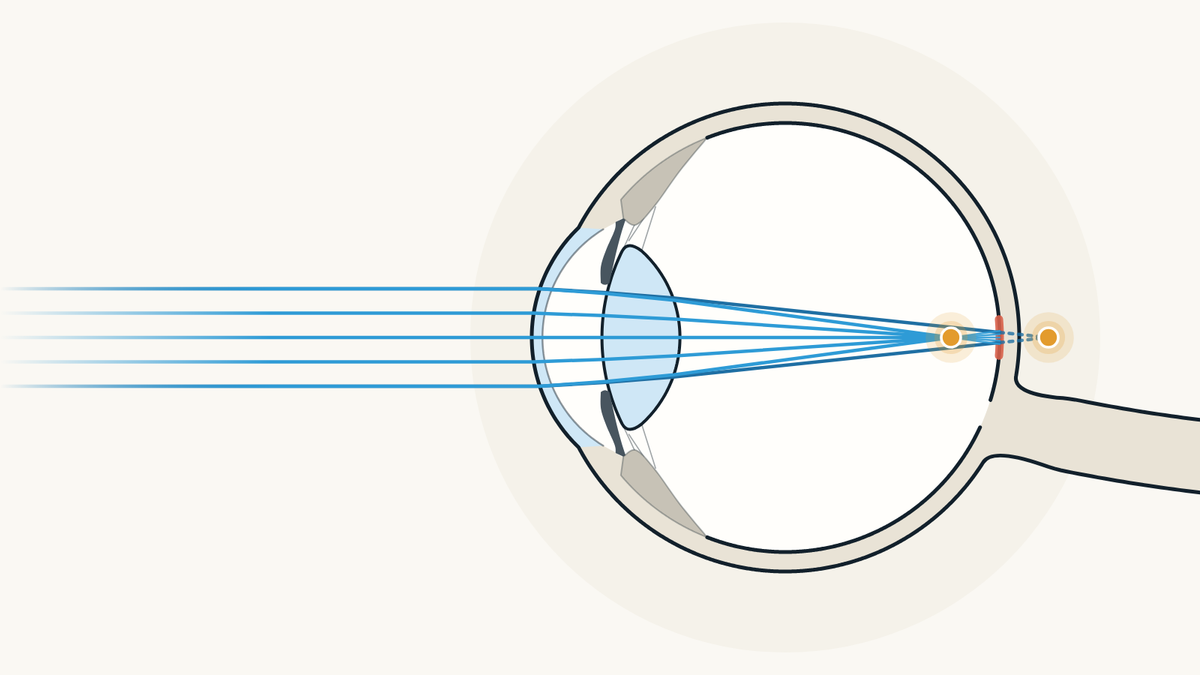
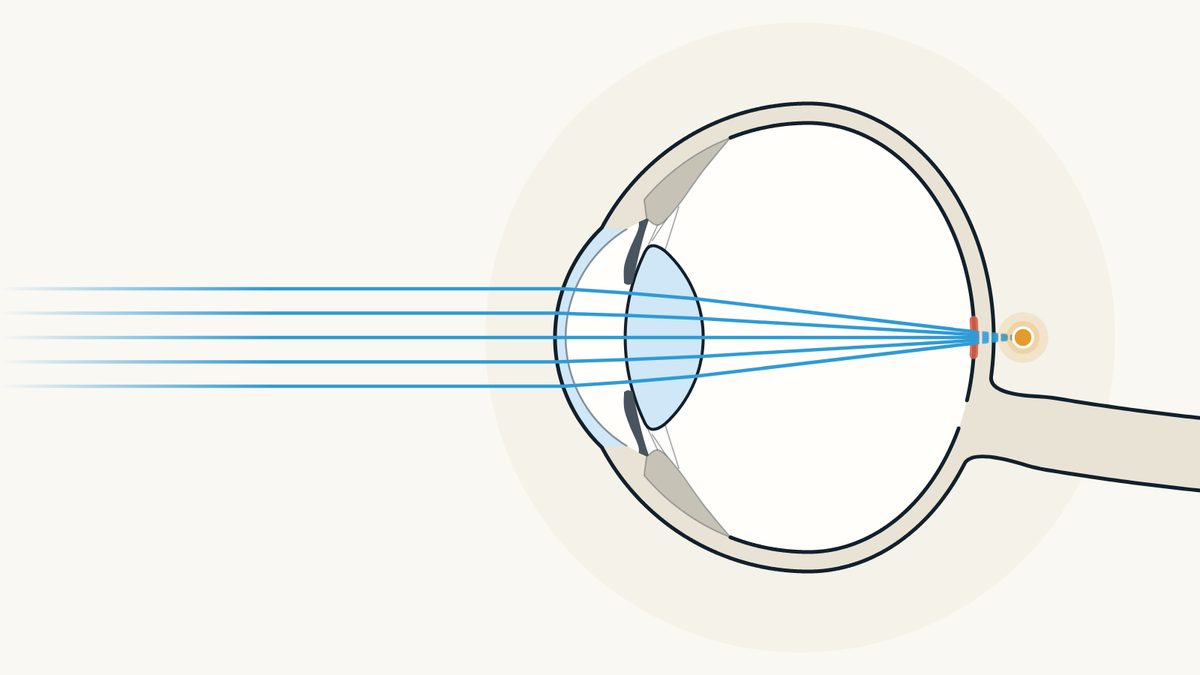
Astigmatism is a common refractive error, not a disease. The cornea or the lens inside the eye is shaped more like a football than a basketball, so light doesn't focus properly on the retina. As a result, vision can be blurry or distorted at every distance. Glasses or contact lenses usually correct it.

Why do people get astigmatism?
According to the Canadian Association of Optometrists (CAO), most people have some astigmatism. A global meta-analysis, counting only astigmatism above a set threshold, estimated that about 40% of adults and 15% of children have it. That threshold varies from study to study.
It comes from small differences in how the parts of the eye grow and line up. Genetics may play a role, and so can pressure from the eyelids on the cornea. Astigmatism can also follow an eye injury, disease or surgery. Less often, keratoconus is the cause.
What are the symptoms of astigmatism?
When astigmatism is strong enough to bother you, common signs include:
- blurry or distorted vision, near and far
- squinting to see clearly
- eye strain or discomfort
- headaches
- lights at night that look smeared or streaked
Children rarely complain, because they often don't realize their vision is blurry.
Why do lights look streaky at night with astigmatism?
A slight halo around headlights at night is common. With significant astigmatism, though, it looks more like a comet, with lines of light radiating out from the centre, explains a Cleveland Clinic ophthalmologist.

An AAO ophthalmologist adds that a very wide pupil in low light can also cause halos, as can dry eye, under-corrected vision or early cataract changes.
What about the yellow-lens glasses sold for night driving? In a simulator study of 22 drivers with normal vision, they didn't help spot pedestrians any faster than clear lenses.
What's the difference between astigmatism and myopia?
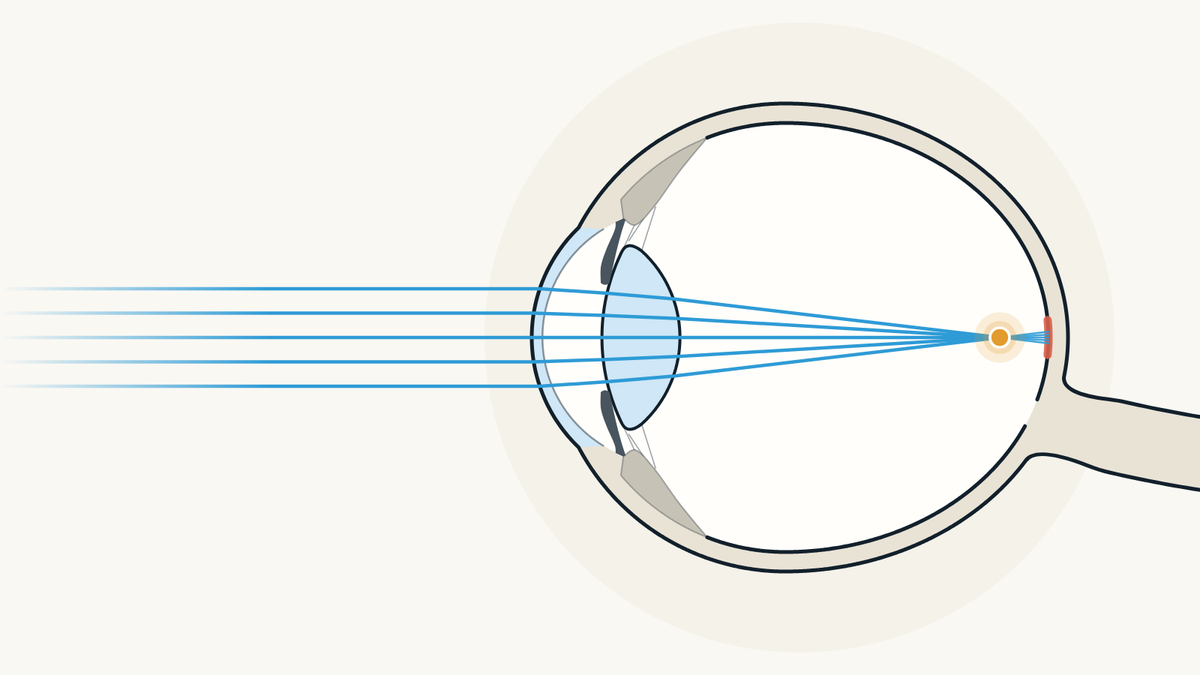
Myopia (nearsightedness) is mainly about the length of the eye: images focus in front of the retina, so distant objects look blurry.
Astigmatism is about shape: the cornea or lens bends light unevenly in different directions, so the blur can affect every distance. It often comes with myopia or hyperopia (farsightedness).
Is astigmatism serious?
Usually not. The CAO describes it as a common vision condition, not a disease. Two situations deserve closer attention, though.
In children
If one eye has much more astigmatism than the other, the brain can start to ignore that eye, and its vision doesn't develop properly. This is amblyopia, or lazy eye.
The AAO advises treating it before age 7 or 8 when possible. It's the eye exam that picks up astigmatism in children.
Keratoconus
This uncommon condition usually starts in the late teens or early twenties. The cornea thins and bulges into a cone shape. Eye allergies, family history and frequent eye rubbing are risk factors.
As keratoconus progresses, the astigmatism becomes irregular and glasses correct it less well, so rigid contact lenses often give clearer vision. Other treatments, such as corneal cross-linking, are discussed with an ophthalmologist.
Can astigmatism get worse or go away?
It can change. According to the AAO and the American Optometric Association (AOA), astigmatism can increase, decrease or stay the same over time, especially as the eye grows and ages. Glasses and contact lenses don't make it go away: they compensate for it while you wear them.
Do you have to wear your glasses all the time?
Not necessarily. Small amounts of astigmatism may not need treatment, says the CAO. According to an AAO ophthalmologist, an adult who can do all their activities comfortably without glasses doesn't need to wear them.
Going without won't damage your eyes, though you may get eye strain or headaches. Wearing glasses won't make your eyes worse either. For children, stick to the wearing schedule you were given, since their vision is still developing.
What do CYL and AXIS mean on your prescription?
CYL is how much astigmatism is corrected, in dioptres; AXIS is its orientation, from 1 to 180 degrees (180 is horizontal). In Québec, an optical prescription gives the spherical, cylindrical or prismatic power in dioptres, according to the Ordre des optométristes du Québec (OOQ).

| Abbreviation | What it tells you |
|---|---|
| SPH (sphere) | Nearsightedness (minus sign) or farsightedness (plus sign), in dioptres. |
| CYL (cylinder) | How much astigmatism is corrected, in dioptres. If the box is blank, the prescription doesn't correct astigmatism. |
| AXIS (AXE on French prescriptions) | The orientation of the astigmatism, from 1 to 180 degrees (180 is horizontal). It says nothing about strength. |
Small amounts of astigmatism, under 1 dioptre, are very common. Whether to correct it depends on your symptoms and needs, not just the number.
Can you wear contact lenses with astigmatism?
Yes. Soft toric lenses are designed to keep their orientation on the eye. Because blinking can rotate them slightly, vision can be a little less stable than with glasses, notes an AAO ophthalmologist.
Rigid gas-permeable (RGP) lenses are often preferred for high or irregular astigmatism.
In Québec, one prescription covers both glasses and contact lenses. According to the OOQ, it may leave out some lens-specific parameters (such as curvature and diameter), which are set by the professional who fills the prescription: an optometrist or a licensed optician.
New to contact lenses? Read our guide to first-time contact lenses.
How long does it take to adjust to astigmatism glasses?
When astigmatism is corrected for the first time, or when the cylinder or axis changes, objects can look slightly distorted or tilted, and your eyes may tire. Wearing your glasses regularly is what lets you adjust; it usually takes a few days, sometimes longer.
Older adults often find the adjustment harder, especially with an oblique axis, which can cause dizziness. A small lab study (24 people) helps explain why.
When should you see an optometrist?
Book an eye exam if:
- your vision is blurry or distorted, or you often squint
- you often have headaches or tired eyes
- lights at night bother you more than they used to
- a teen or young adult's prescription keeps changing, or straight lines look wavy
- you rub your eyes often, especially if you have allergies
As a general guide, PrimeVision recommends an eye exam every two years for adults and every year for children.
The RAMQ offers covered optometric services free of charge to insured people in several situations, including: “You are under the age of 18 or age 65 or over.” For these groups, complete examinations are covered once a year (“1 examination per year”).
Some financial assistance recipients are also eligible. See the RAMQ's Optometric services page for details.
How do you fix astigmatism?
According to the CAO, properly prescribed and fitted glasses or contact lenses correct almost all levels of astigmatism. Options include glasses, soft toric lenses, rigid gas-permeable lenses and orthokeratology (lenses worn overnight), whose effect is temporary. Laser refractive surgery, which reshapes the cornea, is a decision to discuss with an ophthalmologist.

The AAO says the right correction is the one that suits your vision needs and lifestyle. Prescription glasses have the advantage of not rotating when you blink.
If you'd rather go without them for sports or everyday life, our team can assess whether toric contact lenses suit you.
Sources
- Canadian Association of Optometrists. Astigmatism (2024).
- American Academy of Ophthalmology. Astigmatism Explained: Causes, Diagnosis, Treatment.
- American Optometric Association. Astigmatism.
- American Academy of Ophthalmology. What Is Keratoconus? (2026) and Amblyopia: What Is Lazy Eye? (2025).
- Hashemi H. et al. Global and regional estimates of prevalence of refractive errors. Journal of Current Ophthalmology, 2018.
- Cleveland Clinic. 5 Tips for Driving at Night With Astigmatism (2022) and Eyeglasses (Glasses): How They Work & Types (2025).
- Hwang A.D. et al. Comparison of Pedestrian Detection With and Without Yellow-Lens Glasses During Simulated Night Driving. JAMA Ophthalmology, 2019.
- American Academy of Ophthalmology, Ask an Ophthalmologist: halos at night (2019), glasses for astigmatism (2016), not wearing glasses (2023), glasses and nearsightedness (2015), glasses or contacts (2023).
- Elliott D.B. et al. Subjective Verticality Is Disrupted by Astigmatic Visual Distortion in Older People. Investigative Ophthalmology & Visual Science, 2020.
- Ordre des optométristes du Québec. Questions fréquentes : droits du patient et obligations professionnelles (in French).
- Régie de l'assurance maladie du Québec. Optometric services, accessed September 25, 2026.
- Société de l'assurance automobile du Québec. Adding or Removing a Driver's Licence Condition, accessed September 25, 2026.
This article is general information and does not replace an eye exam.