Optical Measurements: Why Pupillary Distance and Fitting Height Matter
What pupillary distance and fitting height are, monocular or binocular PD, how they are measured, what happens when the optical centre is off, whether an app or an online order can do it, and who takes these measurements in Québec.
By Michel Geha, O.O.D.
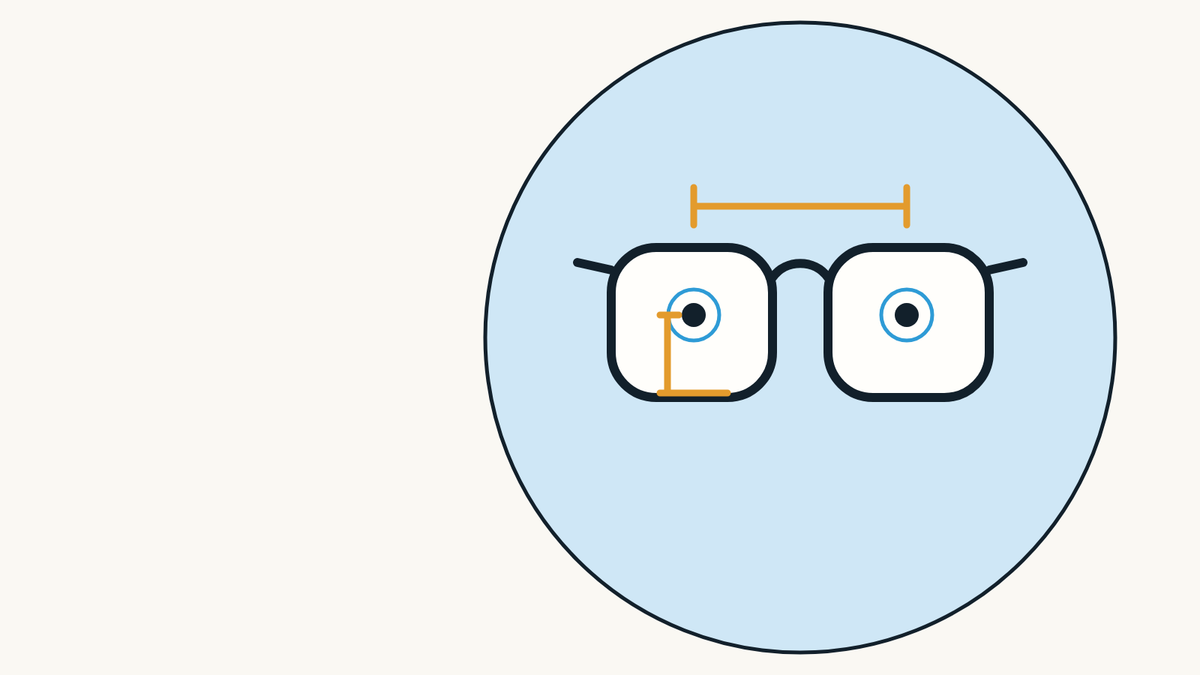
For glasses to correct your vision well, the optical centre of each lens has to sit in front of the pupil. Two measurements place it: the pupillary distance, the distance between your pupils, and the fitting height, taken in the frame you chose. An error can cause eye strain and headaches, especially with a strong prescription.
Which measurements are taken to make glasses?
Mainly the pupillary distance and the height of the optical centre, plus the segment height for bifocal or progressive lenses. That is the list the Canadian Association of Optometrists (CAO) gives when it explains what has to be measured before glasses are ordered.
Not all of these numbers are on your prescription. The prescription says what correction goes into the lenses; the measurements say where to place it in front of your eyes, in one specific frame. To understand the numbers on the prescription itself, see our guide on how to read your glasses prescription.

What is pupillary distance?
It is the distance, in millimetres, between the centre of one pupil and the centre of the other. According to a 2024 article in Community Eye Health, a journal for eye care workers, this measurement is used to place the optical centre of each lens directly in front of each pupil.
The optical centre is the point of the lens where vision is clearest. When it is lined up, light passes through the lens without being bent off to the side.

Monocular or binocular pupillary distance: what is the difference?
Binocular PD is one measurement, from pupil to pupil; monocular PD is taken for each eye separately, from the pupil to the centre of the nose. The same Community Eye Health article sets this out.
Faces are not always symmetrical: one pupil can sit a little closer to the nose than the other. The journal therefore recommends monocular measurement for strong prescriptions, asymmetrical faces and progressive lenses.

How is pupillary distance measured?
With a PD ruler or a pupillometer, while the person looks into the distance. Community Eye Health describes the ruler method step by step: the professional sits facing the person, at eye level, and reads the distance between the pupils.
A pupillometer is a device that takes the same measurement digitally. In a study published in 2023 in Cureus, a digital pupillometer used by a trained examiner was the reference measurement against which the apps were judged.

What happens if the optical centre is in the wrong place?
The lenses bend light off course, which can cause eye strain, headaches and sometimes double vision. A study published in 2023 in Health Science Reports reports eye-strain symptoms and diplopia when the optical centre is off, because of the prism effect that the offset creates.
The CAO also lists the common complaints with poorly measured glasses: headaches, fatigue, nausea, dizziness and a pulling sensation in the eyes. And according to Community Eye Health, a wrongly measured pupillary distance cannot be fixed by an adjustment: it has to be measured again and the lenses remade.

Is a small measurement error always a problem?
Not always: it depends on the strength of the prescription. In a small study published in 2007 in Optometry and Vision Science, lenses up to 1.50 dioptres were unlikely to cause discomfort from decentration.
The prism effect created by an offset grows with the power of the lens. With a strong prescription, a few millimetres can be enough to cause discomfort, so precision matters more.

What is fitting height?
It is the height of the pupil in the frame, measured from the bottom of the lens. For progressive lenses, Community Eye Health recommends marking the pupil position on the demo lenses of the chosen frame, so the wearer looks through the right part of the lens for distance, intermediate and near vision.
With bifocals, the same idea applies to the line of the reading segment. Our article on single vision, bifocal and progressive lenses explains how these zones are laid out.

Why measure in the frame you chose?
Because the frame itself changes where the lenses sit in front of your eyes. According to Community Eye Health, a frame that is too big, too small or poorly adjusted can shift the optical centre, even when the pupillary distance was measured correctly.
That is why fitting height is taken once the frame is chosen and adjusted on the nose and ears. For size, bridge and temple criteria, read our guide on how to choose frames that fit your face.

Can an app measure your pupillary distance?
Some apps give a fairly close value, but their accuracy varies. In the 2023 Cureus study, three phone apps were compared with a digital pupillometer in 44 people: two were on average about half a millimetre from the reference, the third more than a millimetre.
An app measures pupillary distance only. It does not measure the fitting height in your frame, which is essential for progressive lenses.

Are measurements a problem when you buy glasses online?
They can be, because you are the one taking them. The CAO writes that ordering online means taking on the role of a trained optical dispenser, measurements included. It does not recommend buying online for children, for strong, complicated or multifocal prescriptions, or for faces that are difficult to fit.
Studies point the same way. In 2011, in the journal Optometry, at least one lens failed an optical standard in 28.6% of glasses ordered online. A more recent study, published in 2021 in Optometry and Vision Science, found fewer failures, close to one prescription in ten, without testing where the lenses sat in front of the eyes.

Who may take these measurements in Québec?
The licensed optician (opticien d'ordonnances). Under Québec's Opticians Act, quoted by the Ordre des opticiens d'ordonnances du Québec, fitting, adjusting, replacing or selling an ophthalmic lens belongs to this profession, subject to the rights of other professionals, and is done on a physician's or optometrist's prescription.
The Ordre also reminds the public that you are free to deal with the licensed optician of your choice, and that you can get a copy of your prescription from your optometrist.

Where can you have your measurements taken in Montréal?
At PrimeVision, 9520 Boulevard de l'Acadie, Suite 222, in Montréal (Ahuntsic), optometrists and a licensed optician work under one roof. The licensed optician, Michel Geha, O.O.D., takes the measurements in the frame you have chosen, among more than 4,000 frames for every budget, and checks the fit when you pick up your glasses. RAMQ covers eye exams for children under 18 and adults 65+.
To see frame and lens options, visit our prescription glasses in Montréal page, or book from our eye exams in Montréal page.

Sources
- Mehta M, Onyegbule S. Prescribing and fitting spectacles: the role of pupillary distance and the optical centre, Community Eye Health, 2024;37(122):18.
- Buying Glasses Online, Canadian Association of Optometrists, updated March 27, 2023.
- Citek K et al., Safety and compliance of prescription spectacles ordered by the public via the Internet, Optometry, 2011.
- Gordon A et al., Accuracy and Repeatability of Internet-ordered Spectacle Lenses, Optometry and Vision Science, 2021.
- Madrolu VSK et al., Influence of prismatic effect due to decentration of optical center in ophthalmic lens, Health Science Reports, 2023.
- du Toit R et al., Tolerance to prism induced by readymade spectacles, Optometry and Vision Science, 2007.
- Han KD et al., Comparing the Effectiveness of Smartphone Applications in the Measurement of Interpupillary Distance, Cureus, 2023.
- Directives concernant la télépratique, Ordre des opticiens d'ordonnances du Québec (in French).
Find our eye care articles useful? Add PrimeVision as a preferred source in Google.
This article is general information and does not replace an eye exam.