Transition Lenses: Pros, Cons and Who They're Right For
Transition lenses darken in the sun and clear up indoors. Here is what they do well, where they fall short in the car and in the cold, and how to tell if they suit you.
Reviewed by Michel Geha, O.O.D., on September 26, 2026
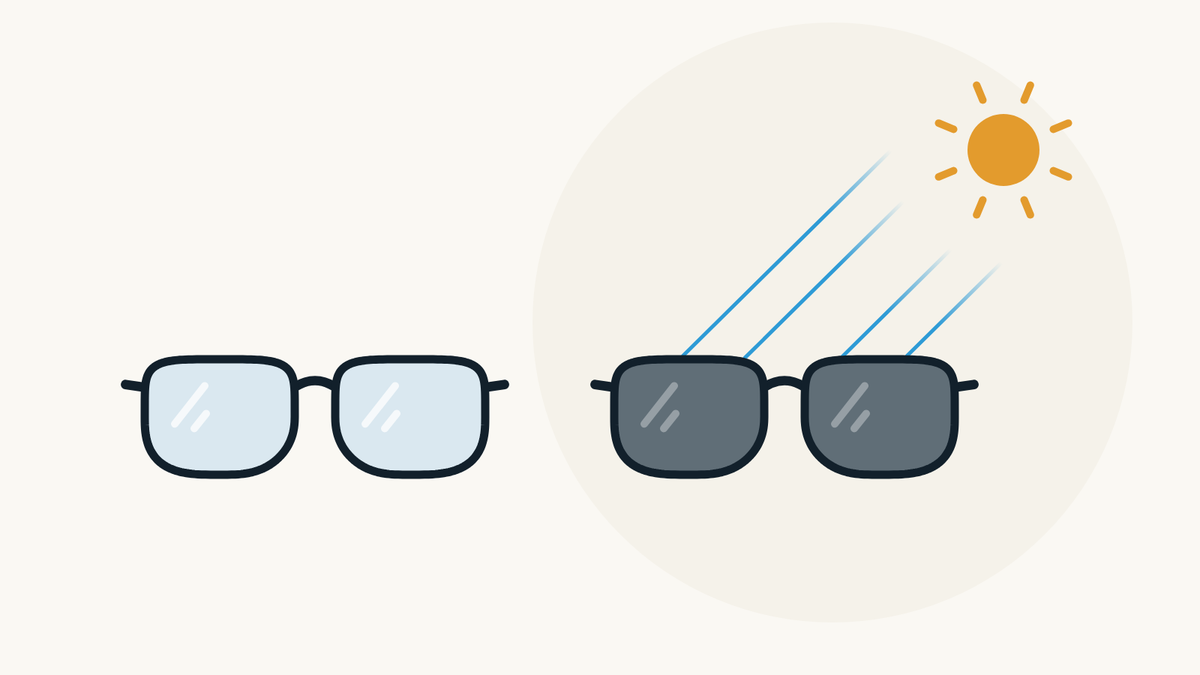
Transition lenses, or photochromic lenses, are eyeglass lenses that darken outdoors when exposed to ultraviolet (UV) light and turn clear again indoors. The everyday name comes from Transitions®, a well-known brand. Their main advantage is one pair for indoors and out. The main drawbacks: standard models barely darken behind a windshield, and cold weather slows their return to clear.
How do photochromic lenses work?
In Health Canada's words: "Photochromic lenses change with the intensity of UV light by turning darker when outdoors and lighter when indoors." These lenses also react to short-wavelength visible light, which helps some models darken in the car. According to the manufacturer, Transitions GEN S lenses start to darken within seconds and usually return to clear in under two minutes. Other brands or older generations can take several minutes. How dark they get and how fast they react also depend on temperature.

Clear or dark, they block UV. The American Academy of Ophthalmology (AAO) says that once activated, photochromic lenses offer the same UVA and UVB protection as regular sunglasses. The manufacturer states that all its models block 100% of UVA and UVB. Health Canada adds that you can't tell how much UV protection a lens gives by its colour or how dark it is.
What are the main benefits?
According to the AAO, they're mostly about convenience:
- One pair for indoors and outdoors.
- UV protection all the time, even on a quick trip outside.
- One less pair to lose.
- Plenty of options: styles, colours and most prescriptions.
Are there any downsides to transition lenses?
Yes. Here's what to know:
- In the car, standard models barely darken, because the windows block UV.
- In the cold, they get darker, but react more slowly and stay tinted longer when you come inside.
- In the heat, they don't get as dark (manufacturer; 2020 study).
- Quality varies: "Some brands darken more than others, and some take longer to adjust" (AAO).
- Standard models aren't polarized: they don't target glare off water or snow.
Do transition lenses work in the car?
Not very well, as a rule. The AAO explains: "Car windows block UV light, which can keep transition lenses from darkening fully." The manufacturer says its standard GEN S lens only reaches a light tint (category 1) behind the windshield and is "not meant to replace prescription sunglasses."

If you drive a lot in daylight, consider:
- Photochromic lenses designed to darken in the car. Transitions XTRActive lenses get dark outdoors (category 3) and, behind a windshield, let through 18% to 43% of light according to the manufacturer's tests on grey lenses at 23°C, which is a medium tint (category 2).
- Prescription sunglasses, polarized or not. Several of the frames in our sunglasses collection can take your prescription lenses.
Do photochromic lenses work in winter?
Yes, but differently. The AAO notes that the lenses "take longer to adjust when it's cold outside."

A 2020 laboratory study measured 12 photochromic lenses from five manufacturers at 6°C and at 21°C. In the cold, the activated lenses were darker (23% of light let through on average, versus 35%) and took 6.4 times longer to get back to nearly clear. The lenses tested aren't necessarily the models sold today, and the study didn't test temperatures below freezing.
So in a Québec winter, expect your lenses to stay tinted for a while when you step into the metro or the office.
If you spend long hours on snow, Health Canada says polarizing lenses are good for outdoor activities in the snow or on water. The AAO adds a caveat: polarized lenses can make icy patches harder to see while driving or skiing.
Is it better to get prescription sunglasses or transition lenses?
It doesn't have to be one or the other. For driving in the sun and water sports, even the manufacturer says sunglasses or polarized lenses are sometimes the better option.

| Situation | Standard photochromic | Car-activated or polarized photochromic | Prescription sunglasses |
|---|---|---|---|
| Indoors | Clear | Slight tint (category 1, per the manufacturer) | Too dark |
| Outdoors in the sun | Darken with UV and temperature | Darker; some also polarize (per the manufacturer) | Fixed tint |
| Behind the windshield | Barely darken | Darken partly (per the manufacturer) | Same tint as outdoors |
| Glare off water or snow | Dimmed, no polarization | Polarized in the sun (polarized models) | Polarization as an option |
| Night driving | Clear (per the manufacturer) | Ask how much light they let through when clear | Don't wear |
Polarization and UV protection are two different things, the AAO points out. Polarized lenses can also make some screens harder to read, such as a dashboard display.
What colour should you choose?
Grey, brown and green are the classic tints. For glare off snow or water, Health Canada suggests "medium to dark lenses with a grey, or slightly brown or green tint." Transitions Optical also offers brighter colours (sapphire, amethyst, emerald, amber and others), which it presents as a style choice.
For what each tint does to your vision, read our article on tinted lenses.
How long do transition lenses last, and what ruins them?
The manufacturer says Transitions lenses "are designed to last the lifetime of your vision care prescription," and that the photochromic dyes are part of the lens, so they can't be scratched off or peeled off. Optics textbooks note, however, that the photochromic effect of plastic lenses gradually weakens over the years (photo-oxidation).
Can progressive lenses also be transition lenses?
Yes. The AAO says photochromic lenses work with most prescriptions, including bifocals and progressives. With bifocals, the choice is narrower. If these are your first progressives, our article on getting used to progressive lenses explains what to expect.
Can you wear transition glasses all the time?
Yes. They're everyday glasses, designed for indoors and outdoors. They're a weaker fit as your only pair, though, if you drive a lot in daylight or spend long hours on water or snow. Models designed for the car keep a slight tint indoors and can darken next to a window that lets UV through.
In front of a screen, standard models stay clear. Advertised blue-violet filtering figures come from the manufacturer, and a 2023 Cochrane review concluded that blue-light filtering lenses may not reduce eye strain from computer use in the short term (low-certainty evidence). Our article on whether blue light glasses work covers the details.
When should you see an optometrist?
Choosing and fitting your glasses
The right choice depends mostly on your prescription and your activities; the frame matters too. Our page on Transitions lenses fitted at our clinic covers the options we offer. For frames, browse our prescription glasses.
Sources
- Health Canada. Sunglasses.
- American Academy of Ophthalmology. Sunglasses With Transition (Photochromic) Lenses: Pros and Cons. 2026.
- American Academy of Ophthalmology. Do transitional lenses have the same UV protection as normal sunglasses? 2022.
- American Academy of Ophthalmology. What Are Polarized Lenses? 2026.
- Moon BY, Kim SY, Yu DS. Differences in the optical properties of photochromic lenses between cold and warm temperatures. PLoS One. 2020;15(5):e0234066.
- College of Optometrists (UK). Tints and driving.
- Singh S et al. Blue-light filtering spectacle lenses for visual performance, sleep, and macular health in adults. Cochrane Database Syst Rev. 2023;8:CD013244.
- Régie de l'assurance maladie du Québec. Optometric services.
- Transitions Optical (manufacturer). Addressing Concerns.
- Transitions Optical (manufacturer). Canadian brochure, 2024.
- Transitions Optical (manufacturer). Frequently asked questions.
This article is general information and does not replace an eye exam.