The 3D Vision Test (Stereopsis): What It Checks at an Eye Exam
What 3D vision (stereopsis) is, how it differs from depth perception, how the polarized-glasses dot test works, what the score in seconds of arc means, what can affect it, why passing is not enough, from what age it is tested and when to see an optometrist.
By Michel Geha, O.O.D.
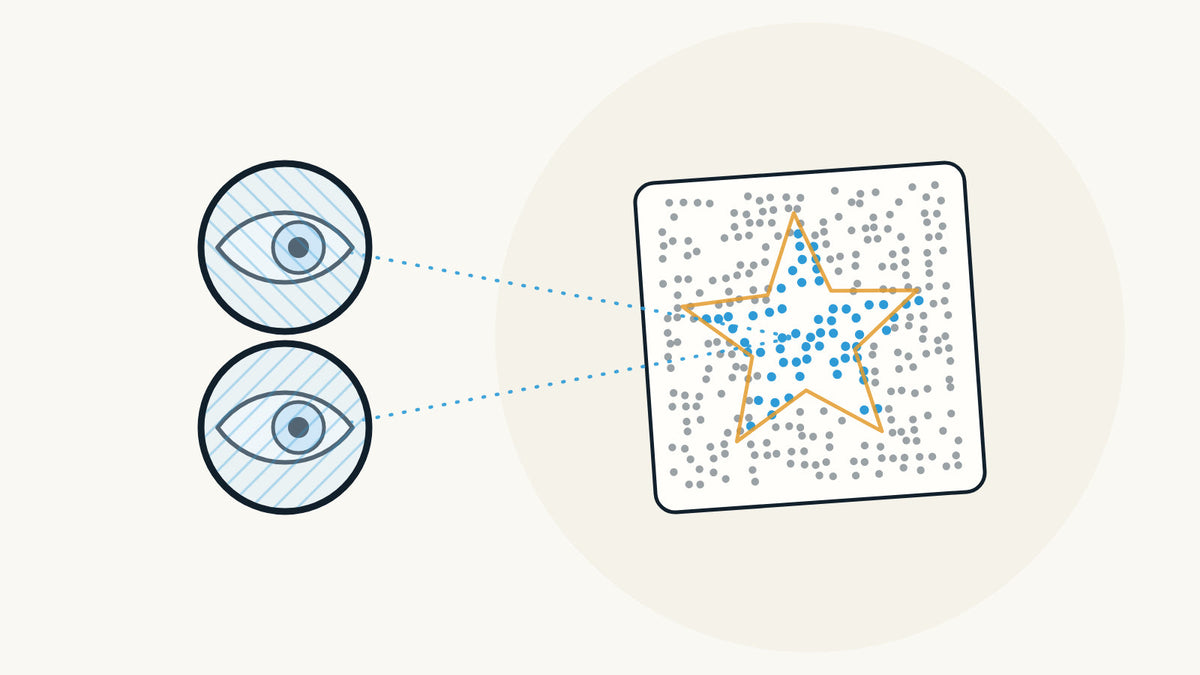
The 3D vision test measures stereopsis, the ability of both eyes to work together to see depth. You take it wearing polarized glasses, looking at a book of dots where shapes only appear when both eyes work together. It helps spot an eye that turns or a lazy eye, but it does not replace a complete eye exam.
What is 3D vision (stereopsis)?
It is the depth you see thanks to both eyes. According to the American Academy of Ophthalmology (AAO), depth perception is the ability to see in three dimensions and to judge how far away an object is. Our two eyes see an object from slightly different angles; the brain compares the two images and forms a single one. When both eyes see clearly and the brain merges the two images well, it is called stereopsis.
The AAO's EyeWiki, an encyclopedia written by ophthalmologists, calls it the highest of the three grades of binocular vision, after simultaneous perception and fusion. That grade is what the 3D vision test measures.

Is 3D vision the same as depth perception?
Not quite. An ophthalmologist answering readers for the AAO puts it this way: stereopsis depends only on the two eyes working together, while depth perception depends on it only in part. The brain also uses clues that one eye can see: a distant object looks smaller, it seems to move more slowly as you move, and an object that blocks another is closer.
A person with only one working eye therefore has no stereopsis, but keeps some depth perception. The AAO adds that people who have seen well with one eye for a long time may have acceptable depth perception, because their brain has adjusted.

How is the 3D vision test done?
You put on polarized 3D glasses and look at a book. According to EyeWiki, these glasses send a different image to each eye, the same principle as some 3D movie glasses. A study published in PLoS One in 2019, with 1,005 children aged 2 to 11, describes the Randot Preschool test: each page holds squares filled with randomly placed dots. In each group of four, one square is flat and the others hide a shape, which only shows up through the glasses.
The child names the shape, or points to it among black-and-white drawings printed alongside. The book is held at 40 cm, as in the reference study by Birch and colleagues (Journal of AAPOS, 2008). The shapes range from easy to very fine: the easiest level is 800 seconds of arc and the finest, 40. There are other tests, such as the Titmus fly test that EyeWiki mentions. Our article on the refraction test describes another step of the exam.

What does the test result mean?
It is the smallest difference in depth you can see. EyeWiki explains that it is given in seconds of arc, a very small unit of angle: a degree holds 60 minutes of arc, and a minute holds 60 seconds of arc. The smaller the number, the finer your 3D vision.
The expected result changes with age. According to Birch and colleagues, who tested 4,355 children, the normal average goes from 100 seconds of arc at age 3 to 60 at age 5, then 40 by about age 7. The 2019 study notes that most older children score 40, the finest score on this test. It also warns that before age 6, a score can change five-fold from one try to the next without any change in vision: a single number is not read on its own.

What can affect 3D vision?
Mostly a problem in one eye. According to the AAO, depth perception can suffer from blurry vision, usually in one eye, strabismus, amblyopia, a nerve problem in one eye or an injury to one eye.
In strabismus, the two eyes do not point in the same direction. The AAO explains that in a young child, the brain learns to ignore the image from the turned eye, and the child loses depth perception; an adult whose strabismus starts later tends to see double instead. In lazy eye (amblyopia), vision in one eye does not develop properly because the brain has learned to ignore it; nearsightedness, farsightedness or astigmatism that is stronger on one side can be the cause.

Does passing the 3D vision test mean everything is fine?
Not necessarily. In the 2019 study, more than 95% of children without a problem passed the test. But about half of the children who had a demonstrable binocular vision problem also scored well. The authors conclude that it cannot be relied on alone to screen for these problems.
That is why the eye exam does not stop there. According to the AAO, amblyopia is found by checking whether vision differs between the two eyes, as part of a complete exam that also looks for other problems. EyeWiki adds that the cover test, where one eye and then the other is covered, should be done in every patient to rule out strabismus. Our article on 20/20 vision also explains why a single number does not sum up the exam.

At what age can 3D vision be tested?
Early, and most children can do the test by age 3. According to EyeWiki, stereopsis is not present at birth and develops at around 3 to 6 months of age. In the 2019 study, 65% of 2-year-olds, 92% of 3-year-olds and nearly all older children could complete the Randot Preschool test.
The AAO recommends checking vision and eye alignment between ages 3 and 5, then again at 5. At PrimeVision, we see children from age 4. Our article on your child's first eye exam explains how to prepare, and the children's eye exams in Montréal page describes the visit.

Can 3D vision improve?
Sometimes, especially when the cause is treated early. The AAO explains that amblyopia is treated by making the weaker eye work: a patch over the stronger eye, drops, or glasses that blur its vision. It generally takes several months, and the AAO advises treating amblyopia before age 7 or 8. These treatments are decided and followed with an ophthalmologist.
For adults with strabismus, the AAO describes eye muscle surgery, prism glasses for mild double vision and exercises when the eyes do not converge well up close. EyeWiki cites the case of Susan Barry, a neurobiology professor who only gained 3D vision as an adult; it is a single described case.

When should you bring it up with an optometrist?
As soon as a sign keeps coming back. According to the AAO, an eye that turns, even now and then, double or blurry vision, trouble reading, a loss of depth perception, or a head you keep tilting or turning to see clearly are signs of strabismus. EyeWiki notes that an unusual head posture in a child can also point to a binocular vision problem.
If depth feels different with new glasses, our article on why new glasses feel strange describes the adjustment period. Double vision that comes on suddenly is another matter: Canada.ca lists it among the signs of stroke and says to call 9-1-1 right away. Our article on double vision covers the causes.

Where can you have your 3D vision checked in Montréal?
With an optometrist, at an eye exam that checks both eyes and their alignment and refers you to an ophthalmologist when needed. For sudden double vision, call 9-1-1.
At PrimeVision, 9520 Boulevard de l'Acadie, Suite 222, in Montréal (Ahuntsic), optometrists and a licensed optician work under one roof. We see children from age 4. The eye exam for adults 18 to 64 includes vision and prescription tests, the health of both retinas and OCT imaging, done with a Canon RS-330. If you have noticed that one eye turns, that your child tilts their head to look at things or misjudges distances, say so at the start of the exam. If the exam calls for an ophthalmologist's opinion, the clinic sends the referral itself and gives you a copy; the wait depends on the hospital or clinic that receives it. RAMQ covers eye exams for children under 18 and adults 65+, and we see children from age 4.
To book, the eye exam in Montréal page describes what the exam includes; book online: the times shown are the open ones. Other eye conditions are gathered in eye conditions from A to Z.

Sources
- Depth Perception, American Academy of Ophthalmology, March 23, 2018, accessed November 23, 2026.
- What is the difference between depth perception and stereopsis?, American Academy of Ophthalmology, June 6, 2019, accessed November 23, 2026.
- Stereopsis and Tests for Stereopsis, EyeWiki, American Academy of Ophthalmology, edited July 21, 2026, accessed November 23, 2026.
- Amblyopia: What Is Lazy Eye?, American Academy of Ophthalmology, November 25, 2025, accessed November 23, 2026.
- What Is Adult Strabismus?, American Academy of Ophthalmology, June 24, 2026, accessed November 23, 2026.
- Eye Screening for Children, American Academy of Ophthalmology, July 10, 2024, accessed November 23, 2026.
- Characterizing the Randot Preschool stereotest: Testability, norms, reliability, specificity and sensitivity in children aged 2-11 years, PLoS One, 2019, 1,005 children, accessed November 23, 2026.
- Randot Preschool Stereoacuity Test: Normative Data and Validity, Birch et al., Journal of AAPOS, 2008, accessed November 23, 2026.
- Stroke, Public Health Agency of Canada, Canada.ca, accessed November 23, 2026.
Find our eye care articles useful? Add PrimeVision as a preferred source in Google.
This article is general information and does not replace an eye exam.