Strabismus (Eye Turn) in Children and Adults: Signs, Causes and Treatment
What strabismus is, esotropia, exotropia and hypertropia, causes in children and adults, the signs, false strabismus in babies, why children do not outgrow it, its effect on vision, double vision in adults, the tests, treatments, surgery and when to get checked.
By Michel Geha, O.O.D.
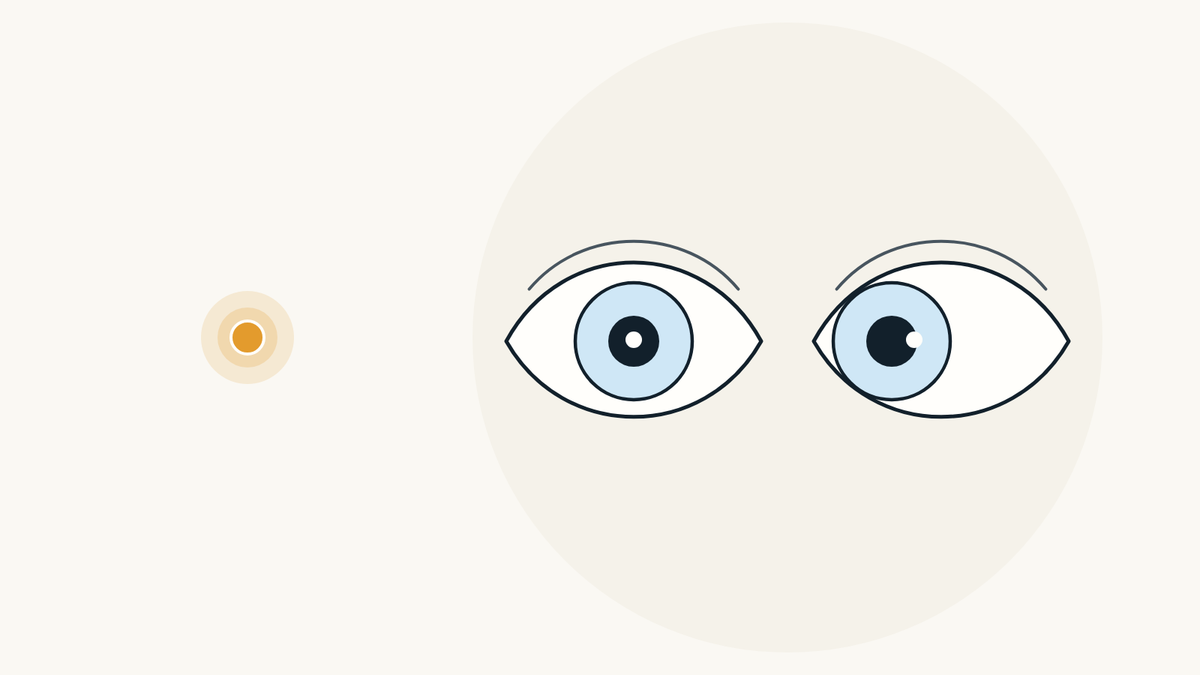
Strabismus is when the two eyes do not point in the same direction: one eye looks straight ahead while the other turns in, out, up or down. In children it does not go away on its own and can lead to a lazy eye. In adults it can be treated too.
What is strabismus?
It is a misalignment of the eyes: they do not point at the same spot. The American Academy of Ophthalmology (AAO) explains that one eye may look straight ahead while the other turns in, out, up or down, and that the turn can shift from one eye to the other. It is also called crossed eyes or an eye turn.
Six muscles attach to each eye and move it. To see a single image, these muscles have to work together, and the brain controls them. The Canadian Association of Optometrists (CAO) estimates that 5% of children have some type or degree of strabismus. The American Association for Pediatric Ophthalmology and Strabismus (AAPOS) puts it at 4% of the US population, and a 2019 review of 56 studies arrived at about 2 people in 100 worldwide. The numbers vary from one country and one study to the next.

What are the types of strabismus?
They are named mainly by the direction of the turned eye. According to the AAO, there are three common types: esotropia, when the eye turns toward the nose; exotropia, when it drifts toward the ear; and hypertropia, when one eye sits higher than the other.
The AAPOS adds that strabismus can be there all the time or only at times. Intermittent exotropia, for example, can show up when the person is tired, sick or daydreaming, or when looking far away. Some esotropias are linked to farsightedness and improve with glasses.

What causes strabismus in children?
Often uncorrected blurry vision, though not always. The AAO says one common reason is nearsightedness or farsightedness: the child strains to see clearly, and that effort can make the eyes cross or drift apart. When the child wears glasses that correct the vision, the alignment can improve.
The AAO also names premature birth, some neurological disorders, Down syndrome, a cataract and an eye injury. The CAO notes that strabismus tends to run in families. In many children, though, it appears with no obvious cause. Our article on farsightedness in children and adults explains why a farsighted eye has to strain to see up close.

What signs should you watch for in a child?
Eyes that look in different directions at the same time. The AAO adds that a child may close one eye or tilt the head to look at something: it can be the child's way of getting both eyes to work together.
The AAPOS also describes children who squint one eye in bright sunlight or rub their eyes when one eye drifts. The CAO points out that parents are often the first to notice a slightly wandering eye. A photo where the flash reflection is not in the same spot in both eyes can also be a clue.

My baby's eyes cross: is that normal?
Sometimes, yes, but not always. The AAPOS explains that many babies look cross-eyed when their eyes are actually straight: a wide, flat nasal bridge with small skin folds at the inner corners of the eyes gives that impression. This is called pseudostrabismus, or false strabismus.
The AAPOS also says that slight crossing that comes and goes is common before about 4 to 5 months of age and generally goes away on its own. It advises having any eye crossing checked after 4 months, and any constant crossing at any age. The CAO recommends a first comprehensive eye exam at 6 months, then a yearly exam from age 3. These are general guidelines: at PrimeVision, children are seen from age 4.

Can a child outgrow strabismus?
No. The CAO is clear that a child will not outgrow strabismus without treatment, and that it may even get worse. The AAO puts it another way: a child can outgrow pseudostrabismus, but not true strabismus.
For intermittent exotropia, the AAPOS notes that the drift may happen less often with age, but that most types do not go away completely. It also reminds parents that a baby with false strabismus can still develop true strabismus later, so follow-up visits still matter.

How does strabismus affect vision?
It keeps the two eyes from working as a team. The CAO explains that a child with strabismus may first see double, since the two eyes are not aimed at the same object. To avoid that double vision, the brain ends up ignoring the image from the turned eye, which is called suppression. Over time, that eye can lose its ability to see well, which can lead to a lazy eye (amblyopia). The National Eye Institute (NEI) lists strabismus among the causes of amblyopia.
Depth perception suffers too. The AAO notes that it may be affected, and the CAO gives everyday examples of what seeing with both eyes allows: pouring a drink into a cup, catching a ball, going up and down stairs, or judging the speed of a car when crossing the street.

Why can an adult have strabismus?
Because they have had it since childhood, or because it started later. The AAPOS separates these two cases. Strabismus present since childhood can become more noticeable over the years, but it usually does not cause double vision.
When strabismus begins in adulthood, the AAO names causes that affect the eye muscles, the nerves that control them, or both: diabetes, thyroid eye disease (Graves' disease), myasthenia gravis, a stroke, a brain tumour, a head injury or eye surgery. The CAO notes that onset in adulthood is rare.

Why does strabismus cause double vision in adults?
Because an adult's brain learned long ago to use the images from both eyes. The AAO explains that it cannot set aside the image from the turned eye the way a young child's brain does, so the person sees two images.
The AAPOS says that strabismus that appears suddenly in an adult almost always causes double vision, and that this is a warning sign to have checked by a doctor. If the double vision goes away when you close one eye, that often means the eyes are no longer lined up. Our article on double vision in one eye or both covers the causes and the signs that call for a quick visit, and our page on urgent eye problems explains what to do.

How is strabismus found?
With simple tests done during a complete eye exam. The AAPOS describes two: a light is shone at both eyes to see where its reflection lands, in the centre of each pupil when the eyes are aligned. Then comes the cover test: one eye is covered, then the other, while the examiner watches how the eyes move.
The AAPOS adds that vision in each eye, eye movements, eye health and the need for glasses are checked as well. The CAO says that a comprehensive exam with an optometrist can determine whether strabismus is present. For your child, see our page on children's eye care from age 4, and our article on your child's first visit to the optometrist.

How is strabismus treated in children?
Depending on the cause, with glasses, a patch, drops or surgery. The AAO explains that glasses can correct strabismus when it comes from blurry vision caused by nearsightedness or farsightedness. The ophthalmologist may also suggest a patch or eye drops to strengthen the weaker eye, which helps the child keep the eyes straight. The NEI explains that the patch or drops go in the stronger eye, so the brain has to use the other one.
The CAO mentions single vision or bifocal glasses, prisms, vision therapy and, in some cases, surgery. The child's ophthalmologist helps choose the right treatment. If your child needs glasses, our article on glasses for kids has tips for choosing a frame that stays on.

How is strabismus treated in adults?
In several ways, and the AAO says it is never too late to treat it. Surgery is the most common treatment in adults. Prism glasses, with a wedge-shaped lens that bends light, can help some people with mild double vision see one image.
The AAO also describes eye exercises, useful when the eyes have trouble turning inward for reading or screens (convergence insufficiency), and botulinum toxin injections into an eye muscle, whose effect can last a few months or become permanent. When strabismus appears suddenly, the AAPOS says doctors first look for the cause, sometimes with blood tests or magnetic resonance imaging (MRI).

What happens during strabismus surgery?
An ophthalmologist operates on the muscles that move the eye. The AAO explains that the surgeon makes a small cut in the tissue covering the eye, then loosens a muscle so it pulls less or tightens it so it pulls more. This can be done on one eye or both, and a second surgery is sometimes needed.
In children, the operation is done under general anesthesia, and most children are back to their routine in 2 to 3 days, according to the AAO. CHU Sainte-Justine's leaflet for parents notes that the child may have pain and discomfort on the first day, then gradually improves. The AAO reminds parents that surgery does not replace glasses or patching if the ophthalmologist recommends them as well. In Montréal, the CHU Sainte-Justine ophthalmology clinic treats children with strabismus who are referred by a pediatrician, a family doctor or an optometrist.

When should you get an eye turn checked?
As soon as you notice that one eye does not look the same way as the other, even only at times. The AAO advises having a child examined who closes one eye or tilts the head to look, and the CAO reminds parents that strabismus does not go away with age.
In adults, an eye turn or double vision that appears suddenly needs a prompt assessment, according to the AAPOS. If headaches come with these symptoms, our article on headaches and vision helps sort things out.

Where can you have strabismus checked in Montréal?
At PrimeVision, 9520 Boulevard de l'Acadie, Suite 222, in Montréal (Ahuntsic), optometrists and a licensed optician work under one roof. The clinic sees children from age 4. If an eye seems to turn, the optometrist examines your eyes or your child's and explains the next steps. When treatment belongs with an ophthalmologist, for example for surgery, the clinic sends the referral directly and gives you a copy; wait times depend on the hospital or clinic that receives it. If glasses are prescribed, the clinic's licensed optician can make them from your prescription. RAMQ covers eye exams for children under 18 and adults 65+.
To book, go through our page to have your eye alignment checked by an optometrist: book online, the times shown are the open ones.

Sources
- Strabismus (crossed eyes), Canadian Association of Optometrists, March 18, 2023.
- Binocular Vision, Canadian Association of Optometrists, January 14, 2025.
- Strabismus in Children, American Academy of Ophthalmology, January 20, 2026.
- What Is Adult Strabismus?, American Academy of Ophthalmology, June 24, 2026.
- Strabismus, American Association for Pediatric Ophthalmology and Strabismus, updated October 7, 2020.
- Adult Strabismus, American Association for Pediatric Ophthalmology and Strabismus, accessed November 2, 2026.
- Pseudostrabismus, American Association for Pediatric Ophthalmology and Strabismus, October 2023.
- Esotropia, American Association for Pediatric Ophthalmology and Strabismus, March 2023.
- Exotropia, American Association for Pediatric Ophthalmology and Strabismus, April 21, 2025.
- Amblyopia (Lazy Eye), National Eye Institute, November 26, 2024.
- Ophtalmologie, CHU Sainte-Justine, September 8, 2026, and its leaflet "Soins postopératoires lors d'une correction pour le strabisme" (in French).
- Global and regional prevalence of strabismus: a comprehensive systematic review and meta-analysis, Hashemi H. et al., Strabismus, 2019.
Find our eye care articles useful? Add PrimeVision as a preferred source in Google.
This article is general information and does not replace an eye exam.