Eye Exams After 65 in Québec: What RAMQ Covers and What's Checked
At 65 and over, RAMQ covers a complete eye exam once a year. Here's what's included, what isn't, and what your optometrist checks for cataracts, glaucoma and AMD.
By Michel Geha, O.O.D.
In Québec, if you are 65 or older and covered by RAMQ, RAMQ covers a complete eye exam by an optometrist, limited to "1 examination per year." The exam is about more than new glasses: your optometrist also checks the lens, the retina and the optic nerve, where cataracts, age-related macular degeneration (AMD) and glaucoma develop.
Does RAMQ cover eye exams after 65?
Yes. If you are insured and 65 or older, the Régie de l'assurance maladie du Québec (RAMQ) covers a complete eye exam once a year, as long as you show your valid Health Insurance Card.

RAMQ's optometric services page covers insured people "under the age of 18 or age 65 or over." Covered services include "examinations to detect vision disorders, monitor their evolution and assess eye health" and the "writing and handing over of prescriptions for eyeglasses or contact lenses (corneal lenses) following an examination."
The limit applies to complete examinations and colour vision evaluation: "Age 65 or over: 1 examination per year."
What isn't covered after 65?
RAMQ lists examples of optometric services you pay for yourself, even after 65. Here are four you may be offered during a visit:

- "Purchase and replacement of eyeglasses or contact lenses, except for under 18s";
- "Fitting of eyeglasses or contact lenses";
- "Photos of the retina or Optomap";
- "Optical coherence tomographies" (OCT, a cross-section scan of the retina).
RAMQ also restricts examinations with dilation of the inner eye and retina: they are "covered for persons being treated for diabetes and those with myopia of 5 diopters or more." If you're offered a test that isn't covered, it's fine to ask what it's for before you say yes. The full list is on RAMQ's Optometric services page.
How often should seniors get an eye exam?
The Canadian Association of Optometrists (CAO) says that "at age 65 and older, adults should have an eye exam at least once a year." Its position statement adds "or as recommended" by your optometrist.

Why yearly? According to the CAO, adults 65 and over are at higher risk of cataracts, glaucoma and AMD, and of low vision: very limited sight that can get in the way of daily activities. For adults under 65, our clinic recommends an exam every two years. For why an exam is worth it even when you see fine, read why eye exams are important.
What does a senior eye exam check?
According to the CAO, a comprehensive exam covers your history, the quality of your vision, the outside and inside health of your eyes, how they focus, how they move and work together, and your side vision. In practice, the visit often goes like this:

- Your history. Your medications, your general health and eye diseases in your family (AAO).
- How well you see. Far and near, with your current glasses, then a measurement of your prescription (CAO).
- Eye pressure and side vision. Two tests that help find glaucoma, according to the American Academy of Ophthalmology (AAO).
- The inside of the eye. The lens, retina, macula and optic nerve, sometimes after drops widen your pupils. Your eyes may then stay sensitive to light for a few hours (AAO).
Cataracts: what shows up at the exam?
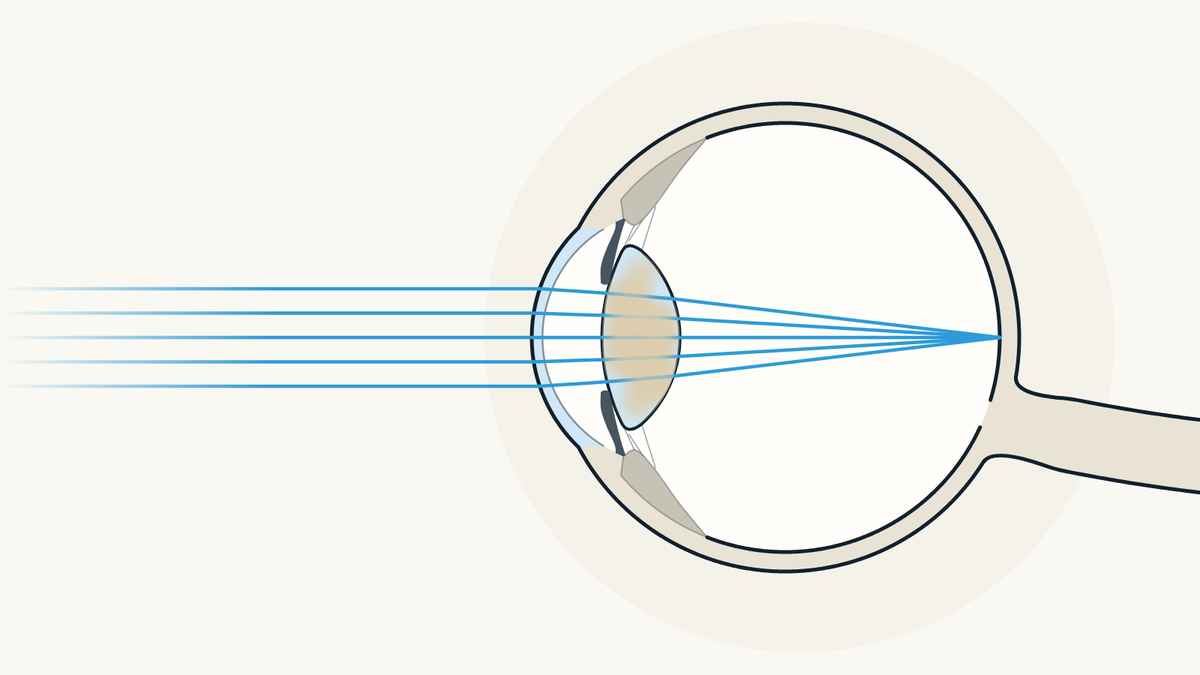
A cataract is when the eye's natural lens becomes cloudy. The AAO says aging is the most common cause, and people over 60 usually start to have some clouding of the lens, though vision problems may not happen until years later.

The National Eye Institute (NEI) says early cataracts cause no symptoms. Later, vision gets blurry, colours look faded, light bothers you more and seeing at night gets harder. The CAO notes that cataracts can mean updated glasses or surgery. Surgery, done by an ophthalmologist, removes the cataract (NEI). Your optometrist follows how it changes and refers you to an ophthalmologist when the time comes.
Glaucoma: why does early detection matter?
Glaucoma damages the optic nerve at the back of the eye. The NEI says it usually has no symptoms at first, which is why, in the US, half of people with glaucoma don't know they have it. People over 60 are among those at higher risk.

When vision does go, it usually starts with side vision. There's no cure, the NEI says, but early treatment can often stop the damage and protect your vision. That's the point of measuring eye pressure, looking at the optic nerve and testing side vision.
AMD: what is your optometrist looking for?
Age-related macular degeneration affects the macula, the central part of the retina you use for sharp, straight-ahead vision. The NEI describes it as one of the main causes of vision loss in older adults. It doesn't cause complete blindness, but losing central vision can make reading, driving or recognizing faces harder.

With early AMD, you may not notice anything for a long time, which is why regular exams matter (NEI). Your optometrist examines the macula and may show you an Amsler grid, a square grid that helps you notice blurry, distorted or blank spots. The AAO suggests people with AMD use one at home to keep an eye on their vision.
What if you have diabetes?
The CAO describes diabetic retinopathy as a weakening of the tiny blood vessels at the back of the eye caused by uncontrolled blood sugar. It can lead to bleeding and swelling of the retina. If you have diabetes, tell your optometrist. For eligible people being treated for diabetes, RAMQ covers the dilated exam of the retina.

When should you see an optometrist before your yearly exam?

What should you bring to your eye exam?
Bring your valid Health Insurance Card, your current glasses and a list of your medications, since your optometrist will ask what you take. Our eye exam in Montréal page explains how the visit works and how to book online.

Sources
- Optometric services, Régie de l'assurance maladie du Québec (accessed October 2, 2026).
- Un optométriste peut-il facturer des gouttes oculaires?, Régie de l'assurance maladie du Québec (in French).
- The Eye Exam, Canadian Association of Optometrists.
- Recommended Frequency of the Comprehensive Eye Examination, Canadian Association of Optometrists position statement.
- Eye Exams 101, American Academy of Ophthalmology.
- What Are Cataracts?, American Academy of Ophthalmology.
- Understanding Macular Degeneration, American Academy of Ophthalmology.
- Cataracts, National Eye Institute.
- Glaucoma, National Eye Institute.
- Age-Related Macular Degeneration, National Eye Institute.
This article is general information and does not replace an eye exam.