Prescription Sunglasses: Lens Options, Tints and UV Protection
Sunglasses can be made for nearly any prescription. Polarized lenses, tints, mirrors, progressives, wraparound frames and UV: what to know before you choose.
By Michel Geha, O.O.D.
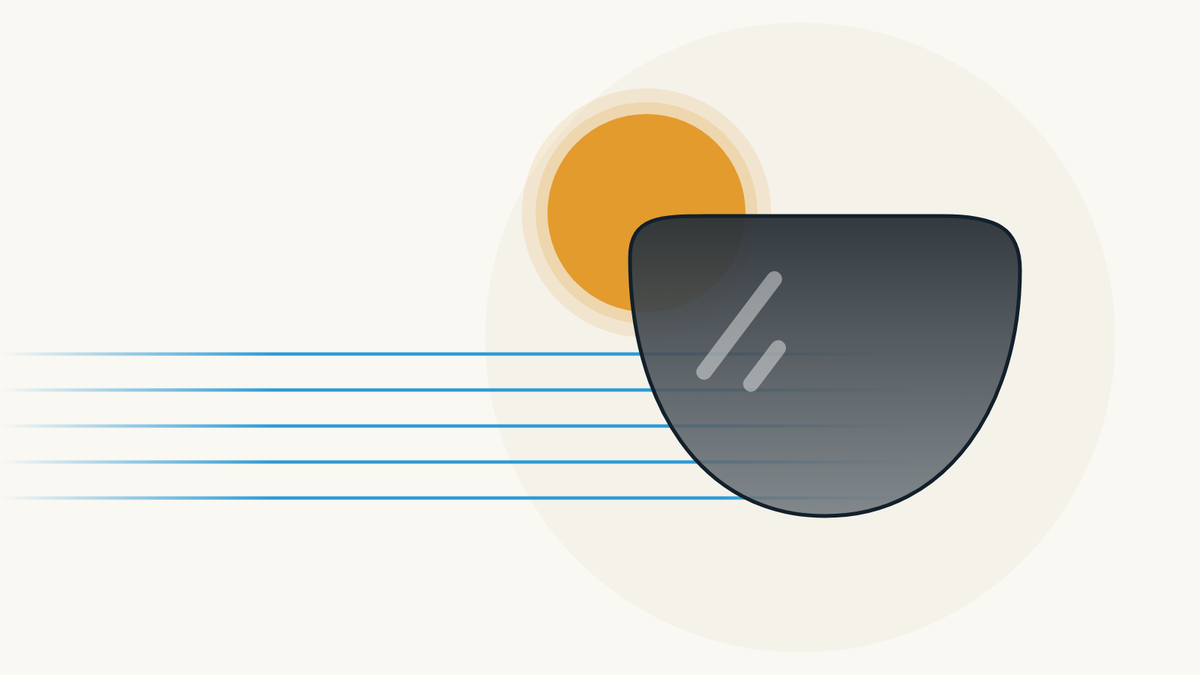
Prescription sunglasses can be made for almost any eyeglass prescription. You then pick the tint colour and darkness, polarization or a mirror finish, and even progressive lenses. What matters for your eyes is UV protection (100% UVA and UVB, or UV400), not how dark the lens looks.
What are your options if you wear glasses?
According to the American Academy of Ophthalmology (AAO), “sunglasses can be made with nearly any lens prescription.” The lenses are made to your correction, then tinted, polarized or coated for what you do. There are other routes too, each with trade-offs.
| Option | Good for | Keep in mind |
|---|---|---|
| Prescription sunglasses | People who spend time outdoors, drive or play sports | One more pair to carry, but sharp vision and a lens chosen for the activity |
| Photochromic lenses | People who want a single pair | Darken less in the car, because car windows block UV (AAO) |
| Contact lenses plus regular sunglasses | Contact lens wearers | Even with UV protection, contacts don’t fully cover the eyes (Health Canada) |
Should prescription sunglasses be polarized?
Light reflected off a flat, horizontal surface such as water, wet pavement or snow vibrates mostly horizontally. A polarized lens has a filter that only lets through light vibrating vertically. So most of that glare is stopped, while a plain tinted lens only dims it. In the AAO’s words, “polarized lenses block glare or horizontal light while vertical light passes through them.”

Health Canada and the Canadian Association of Optometrists (CAO) both point to driving, water and snow as good uses. The AAO also lists some downsides:
- LCD screens (dashboard, phone, ATM) can be hard to read;
- icy patches are harder to spot when driving or skiing;
- they are not meant for night driving;
- polarization itself does not provide UV protection.
Polarized lenses suit fishing, boating and daytime driving. If you read screens outdoors a lot, or your job depends on it, a non-polarized tinted lens may be the more practical choice.
What tint colour and darkness should you get?
Grey cuts light intensity while keeping colours natural; brown can enhance contrast and depth perception (CAO). For glare off snow or water, Health Canada suggests medium to dark lenses with a grey, or slightly brown or green, tint. Our article on tinted lenses goes through each colour.

Darkness is rated in categories from 0 (clear) to 4 (very dark) under the ISO 12312-1 standard, used in Europe among other places. Health Canada’s “general purpose” sunglasses, which block 60 to 92% of visible light, roughly match categories 2 and 3. Category 4, which lets through only 3 to 8% of light, is ruled out for driving.
Do you still need prescription sunglasses if you have transition lenses?
For many people they are: the AAO notes that with photochromic lenses you may not need a separate pair of prescription sunglasses. They darken outdoors under UV and clear indoors. The catch is the car. Windows block UV, so the lenses darken less, though the AAO notes some lenses are designed to work better in cars. Our article on transition lenses covers the pros and cons.
What do mirrored lenses do?
A mirror coating on the front of the lens reflects part of the light instead of absorbing it (Health Canada). It works on top of the tint and comes in several colours such as silver, gold or blue, but Health Canada notes mirror lenses offer no real performance advantage because they scratch easily. One caveat from the AAO: a mirror finish alone won’t fully protect you from UV. That job belongs to the lens’s UV filter.
Can you get progressive lenses in sunglasses?
Yes. Major lens makers offer their sun lenses in single vision and in progressive designs, tinted or polarized. You can read your phone or a trail map and still see clearly far away, in one pair. If you already wear progressives, switching between your clear pair and your sun pair usually takes little adjustment, especially when both pairs use a similar lens design and the sun frame is not strongly curved.
The frame needs enough depth below the pupil for the reading zone. For adaptation tips, see our article on getting used to progressive lenses.
Can wraparound sunglasses take a prescription?
Often, but not always. A wraparound (highly curved) frame gives better side coverage: Health Canada notes that wrap-around sunglasses help keep stray light from entering at the sides. They come with an optical cost, though.

In a wrap frame, the lens sits tilted in front of the eye and is usually steeply curved. That tilt adds power and astigmatism that aren’t in your prescription, and it can shift the image differently for each eye (a horizontal prism effect), which makes seeing with both eyes less comfortable. The lab can compensate your prescription using the frame’s wrap angle, measured once it is fitted to your face, but that compensation only corrects the centre of the lens; a digital lens optimized for that frame also improves the sides. The stronger the prescription, the more these effects matter, so some very curved frames are not advised, or can’t be made. Progressive lenses are especially sensitive to this.
Before you settle on a frame, have it checked against your prescription: the optician will tell you whether it can be made, and with which lens. At PrimeVision, our optician, Michel Geha, O.O.D., does that check in the boutique, takes your measurements and fits the finished pair at the clinic.
How can you tell if sunglasses block UV?
Not by the tint. Health Canada is clear: “You cannot tell how much UV protection a pair of sunglasses will provide by their price, colour, or by the darkness of the lenses.”
Which prescription sunglasses work for driving?
By day, the ISO 12312-1 standard (an international reference used in Europe among other places) allows categories 0 to 3 for driving, not category 4. It also requires that the tint lets you recognize traffic-light colours. Polarized lenses cut glare off wet roads, but they can make dashboard screens harder to read.
When should you see an optometrist?
Sources
- AAO, Taking a Clear Look at Prescription Sunglasses
- AAO, What Are Polarized Lenses?
- AAO, choosing sunglasses to avoid sun damage
- AAO, Transition (Photochromic) Lenses: Pros and Cons
- AAO, What Are Cataracts?
- Health Canada, Sunglasses
- Canadian Association of Optometrists, selecting sunglasses
- College of Optometrists (UK), Tints and driving (ISO 12312-1)
This article is general information and does not replace an eye exam.