Prescription Sports Glasses and Safety Glasses: How to Protect Your Eyes
Why regular glasses are not protection, how common sports eye injuries are, the riskiest sports, possible injuries, lens materials, standards to look for, prescription options, hockey, skiing and cycling, work and home, children, weaker vision in one eye and what to do after a blow to the eye.
By Michel Geha, O.O.D.
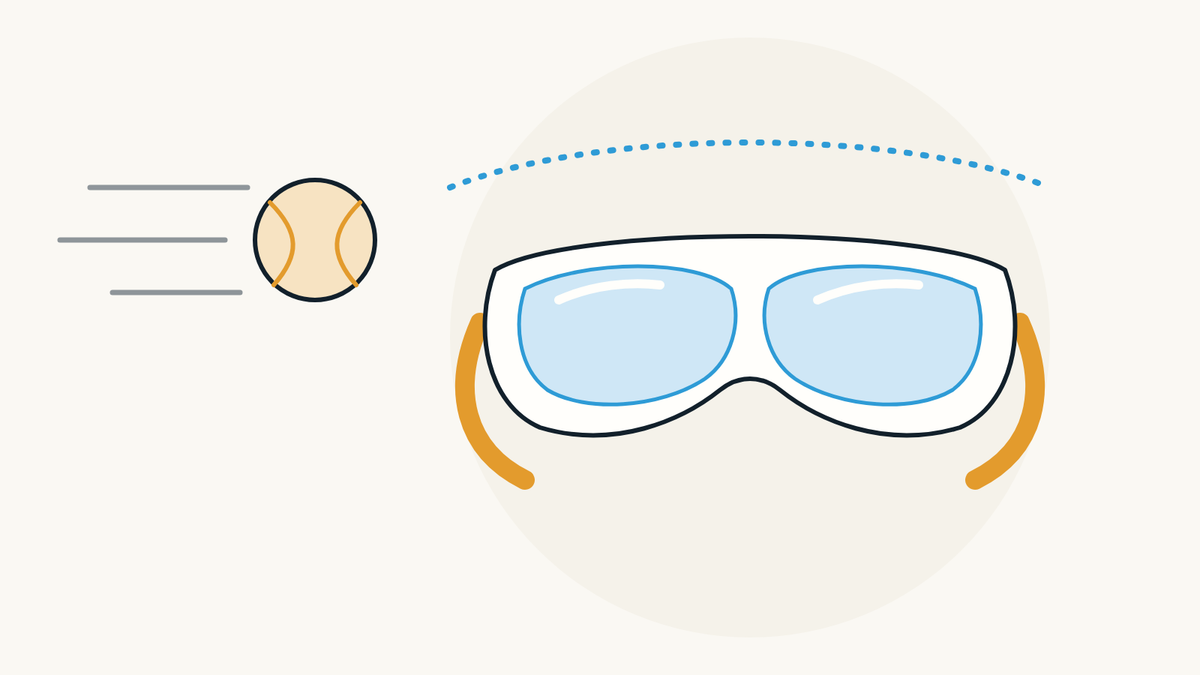
Regular glasses do not protect your eyes during sports: according to the American Academy of Ophthalmology, they can even make an injury worse if they shatter. For a risky sport, wear polycarbonate protective eyewear that meets a recognized standard, with your prescription built in or worn over your glasses.
Do my regular glasses protect my eyes during sports?
No. The American Academy of Ophthalmology (AAO) writes that regular eyeglasses do not offer proper eye protection and, in some cases, can make an injury worse if they shatter. They do not protect against impact, debris or damage.
The risk depends on the sport: each activity calls for its own type of protection, designed and tested for that sport.

Are sports eye injuries common?
Yes. According to the AAO, nearly 30,000 sports-related eye injuries are treated in US emergency rooms every year, and most serious ones could be prevented with proper protection. A survey by the AAO and the American Society of Ocular Trauma found that more than 40% of eye injuries are related to sports or recreation.
In the same survey, more than 78% of the injured were wearing no eyewear at the time. A review published in 2021 estimates that 90% of sports eye injuries could be prevented with suitable protection.

Which sports carry the most risk for the eyes?
In the United States, a study cited by the AAO puts basketball first, followed by baseball, softball, airsoft rifles, pellet guns, racquetball and hockey. Injuries can happen in almost any sport.
Boxing and full-contact martial arts carry a very high risk, and the AAO notes that there is no satisfactory eye protection for boxing.

What injuries can a blow to the eye cause?
From a scratch or bruise on the eyelid to injuries that threaten sight: traumatic cataract, damage to the optic nerve or glaucoma, and open globe injuries, which can lead to permanent vision loss, according to the AAO.
The 2021 review by Ohana and Alabiad adds that a scratched cornea, often from a finger in the eye, may be the most common injury, and that orbital fractures make up almost 10% of sports-related eye injuries.

Which material should sports glasses be made of?
Polycarbonate, or Trivex. The AAO recommends sports glasses with polycarbonate lenses, a plastic that resists shattering and can block UV. It adds that Trivex meets the same safety standards, with less distortion than polycarbonate.
Our article on lens materials compares them with high index and standard plastic.

Which standard should protective eyewear meet?
A standard that matches your activity, marked on the product. For sports such as basketball, racquet sports, soccer and field hockey, the AAO advises eye protectors tested to ASTM standards or that pass the CSA racquet sports standard. For skiing, it names ASTM F659.
For safety glasses at home, the AAO advises a frame or lens marked "ANSI Z87.1". Sunglasses or fashion glasses without that kind of marking are not a substitute for protection.

Can you get sports glasses with your prescription?
Yes. The AAO notes that some safety glasses and goggles are available with prescription lenses, and that others fit over your glasses. A third option: contact lenses to correct your vision, with non-prescription protection on top.
Contact lenses correct vision but do not protect against impact. In the AAO survey, among the injured who were wearing glasses or contact lenses, only about 5% were wearing safety or sports glasses. Our article on contact lenses for sports and travel covers the precautions.

What protection should you wear for hockey?
A helmet with a polycarbonate visor or a wire cage, approved by the Hockey Equipment Certification Council (HECC) or the Canadian Standards Association (CSA), according to the AAO. The same rule applies to lacrosse.
The 2021 review reports that the National Hockey League made half visors mandatory in 2013, and that eye injuries dropped sharply afterward. In 2019, Health Canada recalled helmets, face protectors and goalie masks sold online because they were not certified to CSA standards.

What about skiing, cycling and outdoor sports?
For snow and water skiing, the AAO recommends glasses or goggles that block UV, to protect the eyes from sunburn and glare. For skiing, it names ASTM F659 for high-impact eye protectors.
Even without contact, a fall can hurt the eye: the 2021 review cites orbital fractures from falls while jogging or cycling. For sun protection, see our articles on sunglasses and UV protection and on polarized or photochromic lenses.

Do you need safety glasses at work and at home?
Yes, whenever an activity exposes your eyes to chemicals, debris or objects that can fly, the AAO writes. For home use, it advises protection marked "ANSI Z87.1"; at work, the same protection is often required, and welding calls for more complete protection. Your employer tells you which standard applies to your job.
Home is not as safe as people think: in the AAO survey, nearly half of eye injuries happened at home, and home repairs, yard work, cleaning and cooking caused more than 40% of them. Only 35% of respondents said they always wear protective eyewear for home repairs.

Should my child wear protective eyewear for sports?
Yes, for sports where the eye can be injured. The 2021 review notes that a joint policy statement by the American Academy of Pediatrics and the AAO strongly advocates eye protection for all participants in those sports. In the United States, more than 20,000 of the roughly 42,000 sport and recreation eye injuries each year involve children.
For a child, the protection has to stay on during play. Our article on glasses for kids explains what to check; at PrimeVision, children's eye exams are done from age 4.

Weaker vision in one eye: should you avoid some sports?
At least think about it. The AAO advises people who already see less well with one eye to consider whether a high-risk sport is worth the risk of injuring the other eye, and to ask their eye doctor which protection is available.
In that case, protection that meets the sport's standard is not optional: it is the better eye you are protecting.

What should you do after a blow to the eye?
Get seen quickly, even if the injury seems minor: that is the AAO's main advice. Do not rub or press on the eye. Severe pain, vision loss or a misshapen eye call for urgent care; the 2021 review advises covering the eye with a protective shield, without pressure, in the meantime.
At PrimeVision, urgent problems are seen when there is availability; otherwise, depending on how serious it is, the clinic recommends the hospital emergency department. See our urgent eye care page.

Sports and safety glasses in Montréal: what does PrimeVision do?
At PrimeVision, 9520 Boulevard de l'Acadie, Suite 222, in Montréal (Ahuntsic), optometrists and a licensed optician work under one roof. In the shop, the licensed optician, Michel Geha, O.O.D., helps choose the lens material based on the prescription, the frame and the use, among more than 4,000 frames across a wide range of prices; PrimeVision is an authorized dealer of the brands in its catalogue, including Oakley and Ray-Ban. The clinic also fits soft silicone hydrogel contact lenses. RAMQ covers eye exams for children under 18 and adults 65+.
To see our frames and lenses, visit our page on prescription glasses in Montréal. For an up-to-date prescription before a sports season, see our eye exams in Montréal page: book online, the times shown are the open ones.

When should you see an optometrist?
After any blow to the eye, before a sports season if your prescription is old, and before ordering prescription sports glasses.

Sources
- Sports Eye Safety, American Academy of Ophthalmology, March 11, 2025.
- Safety Glasses: How to Prevent Blinding Eye Injuries, American Academy of Ophthalmology.
- Eye Injury Prevention, American Academy of Ophthalmology, April 14, 2021.
- Eyeglasses: How to Choose Glasses for Vision Correction, American Academy of Ophthalmology, June 14, 2023.
- Ohana O, Alabiad C. Ocular related sports injuries, Journal of Craniofacial Surgery, 2021;32(4):1606-1611.
- GY Sports Hockey Helmets, Face Protectors, and Goalie Masks recalled due to missing CSA Certification, Health Canada, May 13, 2019.
Find our eye care articles useful? Add PrimeVision as a preferred source in Google.
This article is general information and does not replace an eye exam.