Men's Glasses Frames: Size, Shape and Material That Suit You
Whether men's glasses really exist, which frame size suits a wide face, the three numbers on the frame, how to check the fit, face shapes, titanium, acetate or metal, rimless frames, strong prescriptions, work and sports, sunglasses and colour blindness.
By Michel Geha, O.O.D.
There is no such thing as glasses only for men: a good men's frame is, first of all, the right size. It is as wide as your face, rests on your nose without sliding and keeps your eyes centred in the lenses. Material, shape and colour come next, based on your prescription and how you use your glasses.
Are there really men's glasses?
Not strictly: most frames suit anyone, and "men's" sections mostly group wider frames and straighter shapes. The Canadian Association of Optometrists (CAO) lists choosing the right frame size and shape among the key steps to clear, comfortable vision, along with measuring pupillary distance and adjusting the frame to your face.
So start with your face: its width, the shape of your nose and the height of your ears. Our guide to choosing glasses frames covers each step.

What frame size should you choose for a wide face?
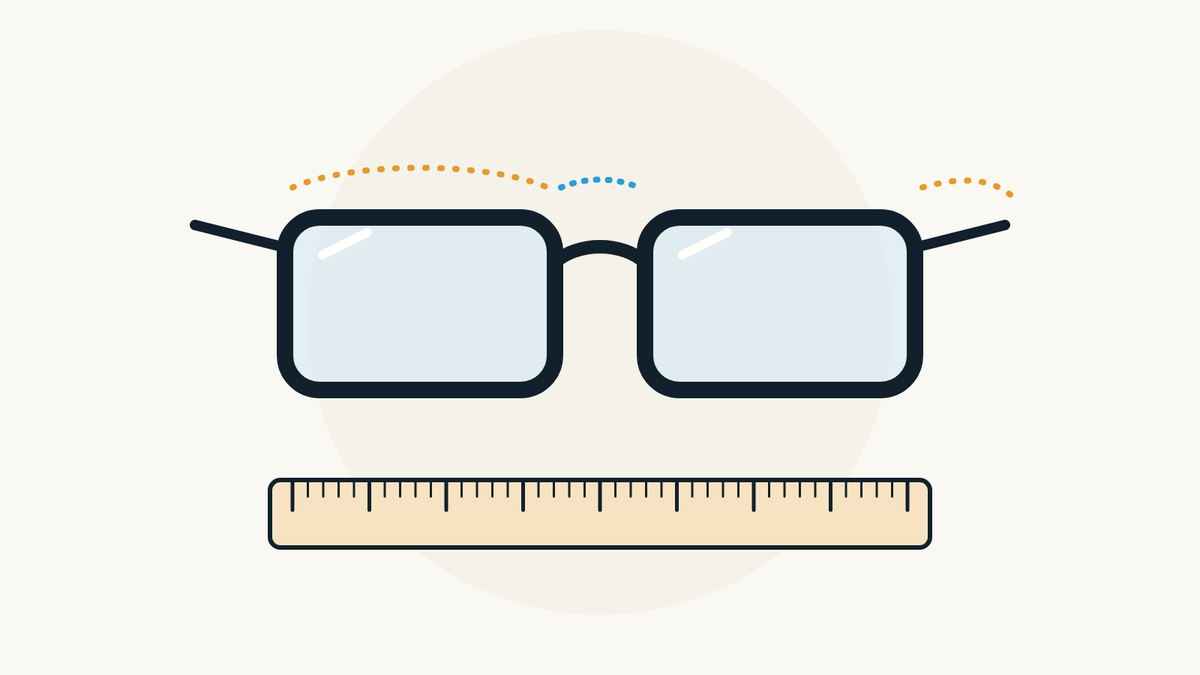
A frame as wide as your face, no more and no less. To compare, read the three numbers on the frame, in millimetres: the width of one lens, the distance between the two lenses (the bridge, which the CAO defines as the shortest distance between the nasal edges of the two lenses) and the length of the temple, which goes behind your ear.
A real example from our catalogue: the Balmain Pierre BPX-150 frame is sold as 53/19-140 and 55/19-140. The bridge and temples are the same; only the lens is 2 mm wider in the second size. If your current glasses fit well, their numbers are a good starting point.

How do you know a frame fits well?
It stays in place without squeezing: it does not slide down your nose when you look down and it leaves no marks. According to the CAO, poorly chosen or poorly adjusted glasses often lead to complaints such as headaches, eyestrain, glasses slipping off the nose and pain or pressure marks on the nose or around the ears.
A wider or flatter nose sometimes needs adjustable nose pads, and a wider head, longer temples. Setting these is the optician's job when your glasses are handed over.

Which frame shape suits a square, round or long face?
The usual shop habit is to play on contrast: more angular shapes for a round face, more rounded shapes for a square face and a taller frame for a long face. It is not a medical rule, and a frame you like that fits well is better than a "recommended" shape.
Our article on choosing a frame goes through each face shape, with examples.

Titanium, acetate or metal: which material should you choose?
It depends on what you are looking for. According to the American Academy of Ophthalmology (AAO), frames made of metal, titanium or alloys stand up well to wear and tear, and titanium is light, strong, corrosion-resistant and hypoallergenic. Plastic frames such as acetate are the most popular: light and available in many colours, but they break more easily than metal.
In our online catalogue, most frames are acetate, with metal, titanium and rimless models too. Our article on frame materials compares each one.

Are rimless glasses a good choice for an active man?
Yes, if you accept a little more upkeep. The AAO notes that rimless or drilled frames are lightweight and work with Trivex or polycarbonate lenses. Since nothing surrounds the lens, the fit needs checking more often.
Our article on rimless glasses explains who they suit and what to watch for.

Which frame should you choose with a strong prescription?
A smaller, well-centred frame with high index lenses. The AAO explains that high index lenses are thin and light, made for strong corrections, and reduce the "coke bottle" look of thick lenses.
For high myopia, the World Health Organization (WHO) recommends a frame that needs smaller lenses: the edge is the thickest part of the lens, and the smaller the lens, the more of that thick edge is cut away when it is shaped. A full frame also helps hide thick edges. Our article on lens thickness shows how the frame changes the result.

Glasses for work or sports: what do you need?
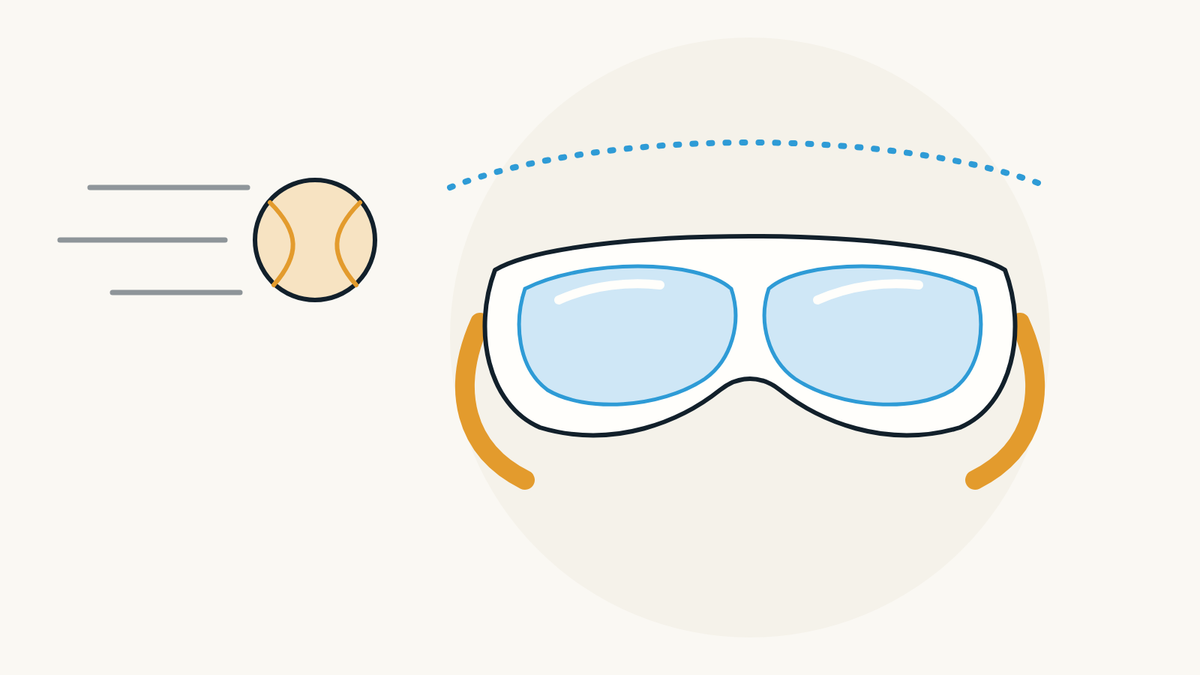
Real protection, not your everyday glasses. The AAO notes that regular glasses do not protect against impact, and advises polycarbonate or Trivex lenses with a standard marked on the frame: CSA or ASTM for sports, ANSI Z87.1 for safety glasses.
See our article on prescription sports and safety glasses.

Men's sunglasses: what should you check?
UV protection first, style second. The AAO advises a label that says 100% UV protection or UV absorption up to 400 nm, and notes that darker lenses do not protect more, that large lenses and wraparound styles block more rays, and that polarization alone does not block UV.
Our article on sunglasses and UV protection goes further.

Is colour blindness more common in men?
Yes. According to the National Eye Institute (NEI), men have a much higher risk than women of colour vision deficiency, which usually runs in families. It is found with a colour vision test; the NEI notes that it does not go away, but that special glasses and contact lenses can help tell some colours apart.
Our article on colour blindness explains the types and the tests.

Men's glasses in Montréal: what does PrimeVision do?
At PrimeVision, 9520 Boulevard de l'Acadie, Suite 222, in Montréal (Ahuntsic), optometrists and a licensed optician work under one roof. In the shop, the licensed optician, Michel Geha, O.O.D., helps you choose among more than 4,000 frames, across a wide range of prices and not only luxury; PrimeVision is an authorized dealer of the brands in its catalogue, including Ray-Ban, Oakley, Tom Ford and Prada, and of Essilor, Hoya and Nikon lenses. Pupillary distance is measured with a pupillometer and a ruler, and the shop does adjustments and minor repairs. Children's eye exams are done from age 4. RAMQ covers eye exams for children under 18 and adults 65+.
To see our frames and lenses, visit our page on prescription glasses in Montréal. Our article on optical measurements and pupillary distance shows what is measured in the shop.

When should you see an optometrist?
Before choosing new glasses if your prescription is old, and as soon as your vision changes. The CAO advises a comprehensive exam for an up-to-date prescription, then the final fitting by the optometrist or optician.

Sources
- Buying Glasses Online, Canadian Association of Optometrists, March 27, 2023.
- Glossary of Common Ophthalmic Terminology, Canadian Association of Optometrists.
- How to Choose the Glasses Frame Material That's Right for You, American Academy of Ophthalmology.
- Eyeglasses: How to Choose Glasses for Vision Correction, American Academy of Ophthalmology.
- Summary guide on quality standards for spectacles, World Health Organization, 2025.
- Safety Glasses: How to Prevent Blinding Eye Injuries, American Academy of Ophthalmology.
- Sunglasses: how to choose them to avoid sun damage, American Academy of Ophthalmology.
- Color Blindness, National Eye Institute.
This article is general information and does not replace an eye exam.