Watery Eyes: Why They Happen and What Helps
Why eyes water, how tears drain, why dry eyes can water, cold and wind, allergies, a blocked tear duct and tear sac infection, eyelid problems, something in the eye, other causes and medicines, babies, what helps at home, how the cause is found, treatments and when to get checked.
By Michel Geha, O.O.D.
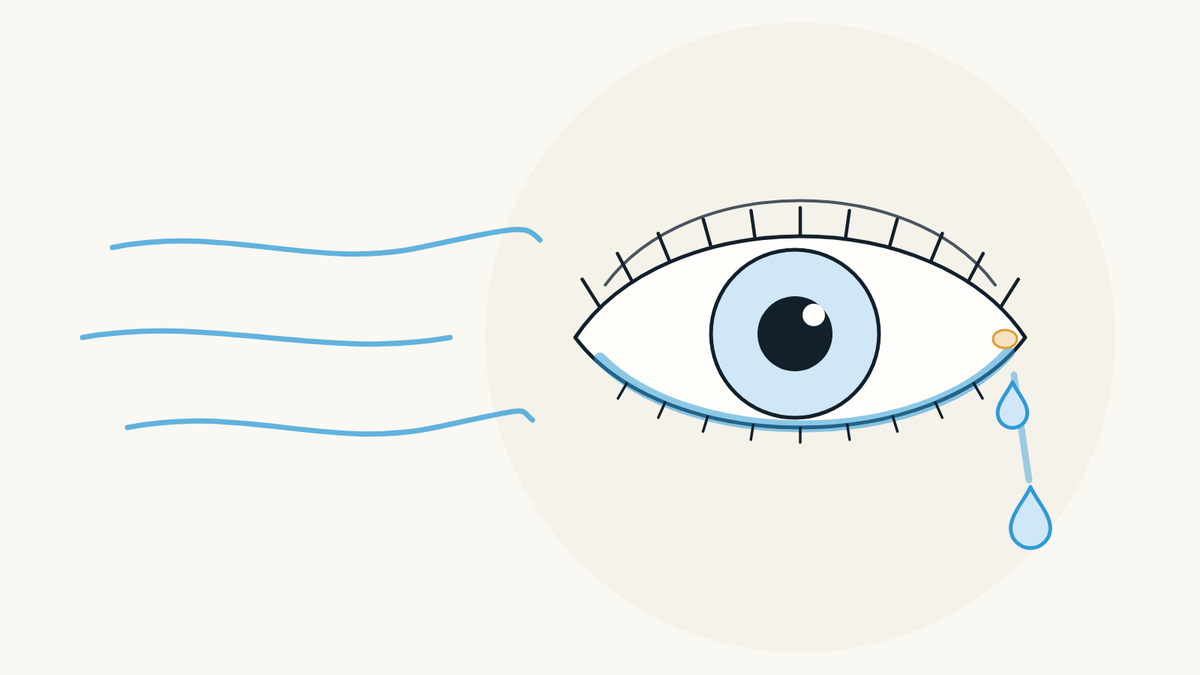
Watery eyes have two main causes: the eye makes too many tears, often because it is dry or irritated, or the tears drain poorly toward the nose, for example when a tear duct is blocked. Wind, an allergy or a loosening eyelid are common causes, and it often clears up on its own.
Why are my eyes watering?
Because the eye makes too many tears or because they drain poorly. The Mayo Clinic explains that the tear glands sometimes make too many tears in response to a dry eye surface, or to any inflammation of that surface: a small object stuck in the eye, an allergy, a viral infection. The medical term is epiphora.
The other route is drainage. In older adults, the skin of the eyelids sags away from the eye, which keeps tears from draining properly into the nose. A tear duct can also become blocked after an injury, an infection or inflammation. Depending on the cause, the Mayo Clinic adds, watery eyes may clear up on their own.

How do tears normally drain?
They start in a gland above the eye and end up in the nose. The American Academy of Ophthalmology (AAO) describes the path: with each blink, tears from the tear glands spread across the eye, enter tiny holes in the inner corners of the upper and lower eyelids, pass through small channels, collect in the tear sac beside the nose, then travel down the nasolacrimal duct into the nose.
The Mayo Clinic compares the tear ducts to a storm drain: they do not make tears, they carry them away. A blockage anywhere along this path, from the tiny holes to the nose, keeps tears from draining and the eye starts to run.

Why can dry eyes water?
Because an eye irritated by dryness protects itself by making more tears. The Canadian Association of Optometrists (CAO) explains that some people have excessive tearing as a result of dry eye: it is a natural reflex, the eye making more tears to comfort itself.
The CAO names several dry eye factors: age, hormonal changes, wind, dry air, pollution, blinking problems, some health conditions and some medicines such as antihistamines. Lubricating drops and a warm compress are a first step. Our article on relieving dry eyes explains the treatments in detail.

Why do eyes water in the cold and wind?
Because wind dries and irritates the eye, and because cold makes a poorly draining duct more noticeable. The CAO counts wind and low humidity among the causes of dry eye. The AAO notes that the symptoms of a blocked tear duct are often more noticeable after exposure to cold, wind or sunlight.
For dry eyes, the AAO advises wraparound sunglasses in the wind and limiting fans and hair dryers. If your eye only waters outside and stops once you are indoors, make a note of it: it is a useful clue for your optometrist.

Is it an allergy?
It may be if your eyes itch while they water. The AAO explains that when an allergen touches the eye, the eye releases histamine: the eyelids and conjunctiva turn red, swell and itch, and the eyes can tear and burn. Often the nose itches and gets stuffy and you sneeze too.
Common allergens are pollen, dust, pet dander, mould and smoke. The AAO advises not rubbing your eyes, wearing glasses outside to keep pollen out and keeping windows closed. To tell an allergy from pink eye, our article compares the two.

What is a blocked tear duct?
It is a tear drainage passage that is partly or fully blocked. The AAO says to think of it particularly when only one eye waters. The main sign is a very watery eye or tears running down the cheek, sometimes worse after a cold or a sinus infection.
In adults, the AAO names long-lasting sinus infections that leave scars, age, which narrows the tiny openings in the eyelids, a nose injury, nasal polyps, and blepharitis, whose thick secretions can clog the duct. More rarely, a tumour presses on the duct. The Mayo Clinic adds that a blocked tear duct can almost always be treated.

What are the signs of a tear sac infection?
A swollen, tender, red inner corner of the eye. When the duct is blocked, bacteria can get trapped in the tear sac: this is called dacryocystitis. The AAO lists its signs: swelling and redness at the inner corner of the eye or around the eye and nose, infections that keep coming back, mucus, crusty lashes, blurry vision, blood-tinged tears and fever.
These signs call for a visit. The AAO says the doctor may give antibiotics if an infection is suspected. The Mayo Clinic adds that you should get checked if the eye gets infected often.

Can an eyelid make the eye water?
Yes. The Mayo Clinic describes ectropion, an eyelid turned outward, usually the lower one: it sags away from the eye, the eye does not close fully and tears no longer drain properly. The result is watery eyes, dryness, a gritty feeling and redness.
Entropion is the reverse: the eyelid turns inward and the lashes rub the eye, which makes it water. Both are more common in older adults, often because the eyelid's muscles and tendons loosen with age. Lashes that grow toward the eye (trichiasis) also cause tearing. Artificial tears bring relief, but the Mayo Clinic says surgery is needed to fully correct ectropion.

What should you do about an eyelash or dust in your eye?
Rinse the eye gently with lukewarm water. Québec's public health institute (INSPQ) advises letting lukewarm tap water run gently over the eye, and removing a visible speck in the inner corner with the corner of a damp tissue.
If it will not come out or the eye keeps watering, the INSPQ says not to insist, to avoid rubbing, to apply a towel wet with cold water and to get seen quickly. For a chemical, rinse right away for 15 to 30 minutes and call the Centre antipoison du Québec at 1 800 463-5060.

What else can make your eyes water?
A cold, pink eye, a stye or blepharitis, among others. The Mayo Clinic also names hay fever, a scratched cornea, inflammation of the cornea (keratitis) and a corneal ulcer. For a bump on the eyelid, see our article on styes and chalazia.
Some medicines also make the eyes water. The Mayo Clinic lists chemotherapy medicines and some eye drops, including those containing pilocarpine, epinephrine or echothiophate iodide. If you think a medicine is involved, talk to the person who prescribed it before changing anything.

Why does a baby's eye water?
Most often because the tear duct is not fully open yet. The Mayo Clinic explains that this is the most common cause of ongoing watery eyes in babies and children. According to the AAO, about 1 newborn in 5 has a blocked tear duct, which usually clears on its own by 4 to 6 months. A 1991 study that followed 4,792 babies found tearing in 20% of them; 96% of those cases had cleared before age 1.
The INSPQ's Mieux vivre avec notre enfant guide notes that the eye may be crusty on waking, with no pain, redness or eyelid swelling, and that you clean it gently with a clean washcloth soaked in lukewarm water. A massage may help the duct open; to learn it, or if the problem lasts past age 1, the guide advises talking to nursing or medical staff. At PrimeVision, children's eye exams start from age 4.

What can you do at home for watery eyes?
When the cause is dryness or irritation, a few simple steps help, according to the Mayo Clinic and the AAO:
- Artificial tears. They may help if the eyes are dry or irritated (Mayo Clinic).
- Warm compress. Held for a few minutes over closed eyes (Mayo Clinic).
- Fewer irritants. Avoid cigarette smoke, limit fans and hair dryers (AAO).
- Moister air. A humidifier at home when the air is dry (AAO).
Avoid rubbing your eyes, which irritates them more, the AAO reminds. If the tearing keeps coming back despite these steps, the Mayo Clinic advises making an appointment.

How is the cause of watery eyes found?
With questions, then an exam of the eye and eyelids. The CAO explains that during an exam, the optometrist asks about your health, your medicines and your home and work surroundings. They can then look at the quality and spread of the tears with a microscope called a slit lamp and special dyes.
When a blocked duct is suspected, the AAO describes tests done by the ophthalmologist: a liquid is put into the duct opening, and if you cannot taste it in your throat, the duct is probably blocked. An X-ray or CT scan may be added.

How are watery eyes treated?
It depends on the cause. For dryness, the CAO puts lubricating drops and a warm compress first, then gels at night, prescription medicines or small plugs placed in the corner of the eyelids to slow tear drainage. For an allergy, the AAO describes antihistamine drops that relieve itching, redness and tearing.
For a blocked duct, the AAO mentions antibiotics if there is an infection, then procedures done by the ophthalmologist to open the duct; in adults, the AAO presents surgery as the usual option. After a face injury, the duct often starts working again on its own within a few months. For an eyelid out of position, the Mayo Clinic says surgery corrects the problem.

When should you get watery eyes checked?
Right away if the tearing comes with vision that drops or changes, pain around the eye or a feeling that something is in the eye: that is the Mayo Clinic's advice. It adds that you should make an appointment if your eyes keep watering.
For a blocked duct, the Mayo Clinic advises getting checked if the eye tears constantly for several days or gets infected often. For an eye that waters and is also red, our article on red eyes lists the urgent signs.

Where can you have a watery eye checked in Montréal?
At PrimeVision, 9520 Boulevard de l'Acadie, Suite 222, in Montréal (Ahuntsic), optometrists and a licensed optician work under one roof. If your eyes water, the optometrist examines your eyelids and the surface of your eyes to look for the cause, then tells you what to do. For dry eyes, the clinic works with I-MED Pharma's I-DROP drops. If a duct or an eyelid needs an ophthalmologist's opinion, the clinic sends the referral directly and gives you a copy; wait times depend on the hospital or clinic that receives it. Urgent problems are seen when there is availability; otherwise, depending on how serious it is, the clinic recommends the emergency department. RAMQ covers eye exams for children under 18 and adults 65+.
To book, go through our page to have a watery eye assessed by an optometrist: book online, the times shown are the open ones.

Sources
- Dry Eye (Ocular Surface Disease), Canadian Association of Optometrists, March 27, 2023.
- What Is a Blocked Tear Duct?, American Academy of Ophthalmology, October 22, 2026.
- Blocked Tear Duct Symptoms, American Academy of Ophthalmology, October 14, 2015.
- Tearing, American Academy of Ophthalmology, February 4, 2021.
- Eye Allergies, American Academy of Ophthalmology, December 8, 2025.
- Remedies to Reduce Dry Eye Symptoms, American Academy of Ophthalmology, May 22, 2024.
- Watery eyes, Mayo Clinic, August 27, 2024.
- Blocked tear duct, Mayo Clinic, August 18, 2025.
- Ectropion, Mayo Clinic, July 25, 2026.
- Entropion, Mayo Clinic, September 19, 2026.
- Problèmes aux yeux chez l'enfant, Mieux vivre avec notre enfant, INSPQ, February 17, 2026 (in French).
- Corps étranger ou produit chimique dans l'œil : que faire?, Mieux vivre avec notre enfant, INSPQ, February 17, 2026 (in French).
- Epiphora during the first year of life, MacEwen C. and Young J., Eye, 1991.
Find our eye care articles useful? Add PrimeVision as a preferred source in Google.
This article is general information and does not replace an eye exam.