Color Blindness: What It Is, How It Is Tested and What Helps
What color blindness is, its types, why it mostly affects men, how it can appear later in life, how colour vision is tested, spotting it in children, cures and colour-blind glasses, jobs, daily tips and when a change in colour vision needs prompt care.
By Michel Geha, O.O.D.
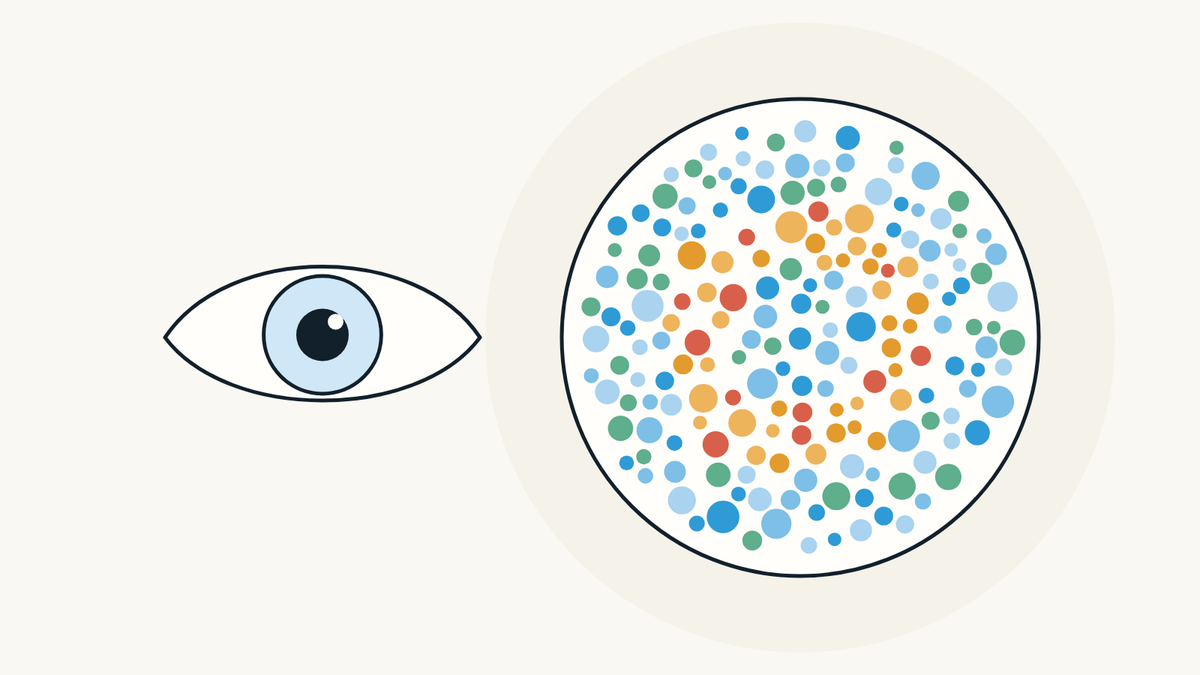
Color blindness, or colour vision deficiency, is difficulty telling certain colours apart, most often red and green. It is usually inherited, mostly affects men and stays stable for life. A simple test made of circles of coloured dots can screen for it.
What is color blindness?
It is colour vision that differs from normal. The American Academy of Ophthalmology (AAO) explains that the eye has three kinds of cones, cells that pick up red, green and blue. When one kind of cone picks up a slightly different colour, or is missing, some colours look alike.
Most often, green and red are confused, sometimes blue. The AAO notes that seeing only grey is rare, and that sharpness of vision is not affected except in the most severe form. Some people see colours well in good light but have more trouble in dim light.

What are the types of color blindness?
There are three main types. The National Eye Institute (NEI) describes red-green color blindness, the most common, whose most frequent form makes greens look redder. In stronger forms, red and green cannot be told apart at all.
Blue-yellow color blindness is rarer: blue is confused with green, and yellow with red or pink. The complete form, called monochromacy or achromatopsia, is very rare; the NEI notes it can come with less sharp vision and light sensitivity.

Why does color blindness mostly affect men?
Because of the X chromosome. The NEI explains that the gene for red-green color blindness sits on the X chromosome. Men have only one, so a single affected copy is enough. Women have two, and both must be affected, which is rare.
Figures vary a little by source: the NEI says about 1 in 12 men, and an AAO page says 5 to 8% of men versus 0.5% of women for the red-green form. The NEI adds that the blue-yellow and complete forms affect women and men equally.

Can color blindness appear later in life?
Yes, that is acquired color blindness. The AAO lists disease, trauma, the toxic effect of some medicines such as hydroxychloroquine, and metabolic or vascular disease. It mostly comes from damage to the retina or the optic nerve.
The NEI also names glaucoma, macular degeneration, multiple sclerosis, Alzheimer's disease and retinal detachment, and notes that colour vision can fade with age, often because of a cataract. Unlike the inherited form, the AAO notes that acquired color blindness often affects one eye more than the other and gets worse over time.

How do you know if you are color blind?
Often, you don't. The AAO says many people do not know they are color blind, and that parents sometimes notice when a child is learning colours. The NEI adds that symptoms are often mild and people adjust to them.
The Mayo Clinic notes that people often find out by mixing up traffic light colours or colour-coded school material. The only way to be sure is a colour vision test.

How is colour vision tested?
With plates of coloured dots. The AAO explains that the Ishihara plates are one of the most common tests: each circle is made of dots of different colours and sizes and hides a number, a letter or a line that a color blind person sees poorly or not at all.
There is a version where you trace a line with your finger, for people who cannot read numbers yet. The AAO notes that more detailed testing may follow, and that a colour test is not part of every routine exam: it is mostly done when there is a family history or a doubt. Our article on why eye exams are important explains what else an exam checks.

How do you spot color blindness in a child?
By paying attention while they learn colours. The NEI says color blindness is hard to spot in children, who may even hide it, and that it can make reading from the board harder when colours are used. It advises testing when there is a family history or when a child has trouble learning colours.
The NEI adds that a color blind child may need small adjustments in class. At PrimeVision, children's eye exams start from age 4; our article on your child's first eye exam explains how it goes.

Can color blindness be cured?
Not the inherited form. The AAO says there is no treatment for congenital color blindness, and that it usually causes no significant disability. The NEI notes that genetic forms do not get better or worse over time.
For acquired color blindness, the cause is treated: the AAO and the NEI explain that if a medicine is involved, the doctor may adjust the dose or switch medicines. The NEI and the Mayo Clinic mention gene therapy as an area of research, not a treatment offered for common color blindness.

Do colour-blind glasses work?
They help some people, with limits. The AAO explains that these glasses filter part of the light between green and red, which can improve contrast in some milder forms of red-green color blindness. Results vary, the effect lasts only while they are worn, and they do not repair the eye.
The Canadian Association of Optometrists (CAO) is clear: tinted lenses, in glasses or contact lenses, change contrast but do not increase the number of shades seen and do not give true colour vision. The AAO adds that they reduce light and may be a poor choice at night. Our article on tinted lenses explains what each lens colour does.

Does color blindness limit some jobs?
Some, yes. The NEI notes that adults may need adjustments in jobs where colour matters, giving graphic design as an example. Some jobs require a colour vision test.
The CAO states that tinted lenses for color blindness are not suitable for jobs with colour vision requirements, and that it does not support using them to pass a workplace test, since they may invalidate the result where public safety is at stake. For inherited color blindness, the CAO says the optometrist counsels on how it affects work and daily life.

How do you live day to day with color blindness?
With a few cues. The Mayo Clinic suggests learning the order of traffic lights rather than their colour, and labelling your clothes. The NEI mentions apps that name colours using the phone's camera.
The NEI notes that most color blind people have no trouble with everyday activities. When a task depends on colour, telling your school or workplace lets them plan the adjustments the NEI describes.

When does a change in colour vision need prompt care?
When the change is sudden or getting worse. The AAO advises seeing a doctor right away if colour vision changes suddenly or worsens, since a significant change can signal a more serious problem. It notes that failing vision or dark or white spots may show up first.
Inherited color blindness does not change. If you notice a change in one eye only, or along with vision that is dropping, our urgent eye care page explains what to do first.

Where can you have your colour vision checked in Montréal?
At PrimeVision, 9520 Boulevard de l'Acadie, Suite 222, in Montréal (Ahuntsic), optometrists and a licensed optician work under one roof. If you or your child mix up certain colours, mention it to the optometrist during the eye exam: the exam also checks the health of your eyes, which matters when colour vision changes over time. Children's exams start from age 4. If a referral to an ophthalmologist is needed, the clinic sends it directly and gives you a copy. RAMQ covers eye exams for children under 18 and adults 65+.
To book, go through our eye exam with an optometrist in Montréal page: book online, the times shown are the open ones.

Sources
- What Is Color Blindness?, American Academy of Ophthalmology, July 2, 2026.
- How Color Blindness Is Tested, American Academy of Ophthalmology, August 25, 2017.
- Do Colorblindness Glasses Really Work?, American Academy of Ophthalmology, March 8, 2021.
- Color Blindness, National Eye Institute, November 5, 2025.
- Types of Color Vision Deficiency, National Eye Institute, August 7, 2023.
- Causes of Color Vision Deficiency, National Eye Institute, January 30, 2025.
- Color blindness: Symptoms and causes, Mayo Clinic, January 10, 2025.
- Color blindness: Diagnosis and treatment, Mayo Clinic.
- Position statement: Colour Vision Deficiency and Specialty Tinted Lenses, Canadian Association of Optometrists, October 26, 2018.
Find our eye care articles useful? Add PrimeVision as a preferred source in Google.
This article is general information and does not replace an eye exam.