Digital Eye Strain: Why Screens Tire Your Eyes and the 20-20-20 Rule
What digital eye strain is, why screens tire the eyes, the 20-20-20 rule, screen distance and glare, dry eyes, blue light, computer glasses, contact lenses, children and screens, and when to get checked.
By Michel Geha, O.O.D.
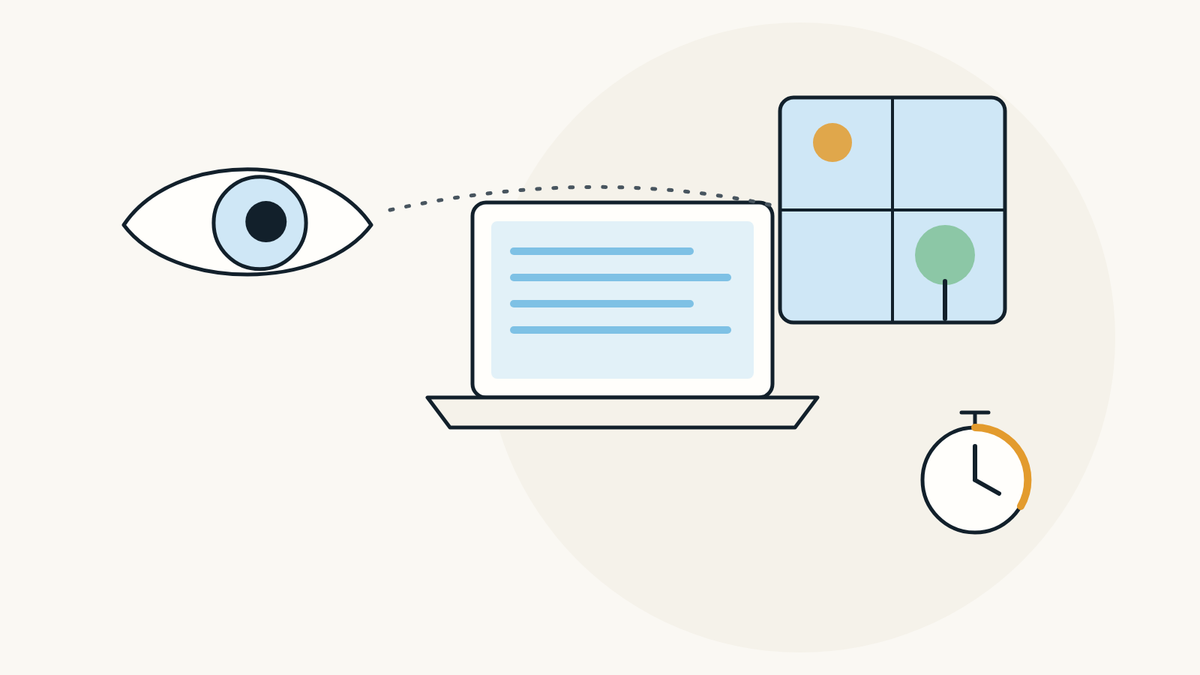
Digital eye strain is eye discomfort after long hours at a screen: dry or red eyes, blurry vision, headaches. It comes mostly from blinking less and focusing up close without breaks. It causes no lasting damage, and the 20-20-20 rule helps prevent it.
What is digital eye strain?
It is a group of symptoms linked to screens. The Canadian Association of Optometrists (CAO), which also calls it computer vision syndrome, lists blurry or double vision, dry, red, irritated, tired or watery eyes, and headaches.
The Mayo Clinic adds burning or itching eyes, light sensitivity, trouble concentrating and neck, shoulder or back pain. The American Academy of Ophthalmology (AAO) notes that this strain causes no lasting damage to the eyes.

Why do screens tire the eyes?
First, because you blink less. The CAO explains that when staring at a screen, people blink about 4 times a minute, compared with 17 on average. The AAO gives similar figures: about 15 times a minute normally, 5 to 7 times at a screen. Tears evaporate and the eyes dry out.
The Mayo Clinic notes that the risk is greater with two or more hours in a row at a screen each day, and that dry air from a fan, heating or air conditioning makes the discomfort worse.

Why is close work demanding for the eyes?
Because two systems work non-stop. The CAO explains that up close, the muscles that focus (accommodation) and the ones that turn the eyes inward (convergence) work continuously and can tire.
The American Optometric Association (AOA) adds that on-screen text is often less sharp than print, with less contrast and more glare. Uncorrected nearsightedness, farsightedness, astigmatism or presbyopia make screens even less comfortable, according to the CAO and the AOA.

What is the 20-20-20 rule?
It is a regular break for your eyes. The AAO describes it this way: every 20 minutes, look at something at least 20 feet, about 6 metres, away for at least 20 seconds. The CAO and the AOA recommend the same rule.
The CAO also advises remembering to blink. The AOA also advises a 15-minute break after two hours of continuous screen use.

How far away should your screen be?
About arm's length. The AAO recommends sitting about 25 inches (64 cm) from the screen, with your gaze slightly downward. The CAO says more than 50 cm, with the screen about 20 degrees below eye level.
The Mayo Clinic advises placing the top of the screen at or just below eye level. The AOA gives similar markers: the centre of the screen 15 to 20 degrees below eye level, about 20 to 28 inches (50 to 70 cm) away.

How do you cut glare and set up your screen?
By adjusting the light around you. The AAO advises matching screen brightness to the room, raising the contrast and using a matte filter to cut glare. The CAO also suggests keeping the screen clean.
The Mayo Clinic recommends not placing the screen in front of a window or a white wall, dimming overhead lights where possible, and enlarging the text. The CAO also recommends a bigger font.

What helps dry eyes at the screen?
Blinking on purpose and using artificial tears. The AAO advises artificial tears when the eyes feel dry, and a humidifier in a dry, warm room. The CAO suggests asking your optometrist which drops to choose.
The Mayo Clinic advises avoiding drops that "whiten" red eyes. It notes that preservative-free drops can be used as often as needed, and drops with preservatives no more than four times a day. Our article on dry eye treatment goes further.

Does blue light from screens damage the eyes?
No, according to the AAO. It says there is no scientific evidence that blue light from devices damages the eye, that the sun is the main source of it, and that it does not recommend special blue light-blocking glasses for computer use. The discomfort comes from blinking less.
A 2023 Cochrane review, which pooled 17 trials, concluded that blue-light filtering lenses may not reduce visual fatigue, with low certainty. The AAO notes that evening blue light can make it harder to fall asleep. Our article do blue light glasses work? covers these studies.

Can computer glasses help?
Yes, when vision at screen distance is the issue. The AAO explains that computer glasses are prescription glasses focused for screen distance, about 51 to 66 cm, and that some are multifocal. It notes they are not blue light glasses.
The AOA notes that even a small uncorrected or under-corrected prescription matters, and that glasses not suited to screen distance make you tilt your head, which leads to neck pain. A 2018 review in BMJ Open Ophthalmology notes that a small uncorrected astigmatism is enough to reduce comfort at the screen. Our article on computer glasses compares the lens types.

What about contact lenses?
It helps to alternate with glasses. The AAO suggests that contact lens wearers switch to glasses to rest their eyes, especially during long screen sessions.
The AAO also reminds wearers not to sleep in contact lenses, even "extended wear" ones. Our article on contact lenses and dry eyes has more tips.

Do screens damage children's eyes?
The AAO says there is no evidence that screen use harms children's eyes. It notes, however, that more screen time is linked to myopia, and that outdoor play may slow myopia.
The AAO cites the American Academy of Pediatrics: no screens before age 2, except video calls, and no more than one hour a day from 2 to 5. The Mayo Clinic also advises limiting screen time, especially for children. At PrimeVision, children's exams start from age 4.

When should you get checked for eye strain?
When tips are not enough. The AAO advises seeing an eye doctor if your eyes are often red, your vision stays blurry, or your eyes are watery, light-sensitive or painful. The Mayo Clinic recommends seeing an eye specialist if self-care does not help.
The AOA explains that a comprehensive exam checks vision at working distance, focusing and how the eyes work together. If headaches keep coming back after screen time, also read headaches and vision.

Where can you have screen-tired eyes checked in Montréal?
At PrimeVision, 9520 Boulevard de l'Acadie, Suite 222, in Montréal (Ahuntsic), optometrists and a licensed optician work under one roof. If your eyes burn or your vision blurs after computer work, the optometrist checks your vision at screen distance and the state of your eyes. For dry eyes, the clinic works with I-MED Pharma's I-DROP drops. For computer glasses, the optician takes your measurements, and the clinic is an authorized dealer of Essilor, Hoya and Nikon lenses. RAMQ covers eye exams for children under 18 and adults 65+.
To book, go through our eye exam for screen-tired eyes page: book online, the times shown are the open ones.

Sources
- Computer Vision Syndrome (Digital Eye Strain), Canadian Association of Optometrists, March 27, 2023.
- 20-20-20 Rule, Canadian Association of Optometrists, March 27, 2023.
- Computers, Digital Devices, and Eye Strain, American Academy of Ophthalmology, June 27, 2024.
- Should You Be Worried About Blue Light?, American Academy of Ophthalmology, March 10, 2021.
- Digital Devices and Your Eyes, American Academy of Ophthalmology, October 23, 2026.
- Eyestrain: Symptoms and causes, Mayo Clinic, July 2, 2024.
- Eyestrain: Diagnosis and treatment, Mayo Clinic, July 2, 2024.
- Blue-light filtering spectacle lenses for visual performance, sleep, and macular health in adults, Singh S. et al., Cochrane Database of Systematic Reviews, 2023.
- Digital eye strain: prevalence, measurement and amelioration, Sheppard A. L. and Wolffsohn J. S., BMJ Open Ophthalmology, 2018.
Find our eye care articles useful? Add PrimeVision as a preferred source in Google.
This article is general information and does not replace an eye exam.